Fewer complaints and late rent payments after a tenant-and-HOA app shipped in under a year
An iOS and Android app for Dutch homeowners' associations: invoices, in-app chat, notifications and multi-association profiles, built on Java and Ionic.
- from concept to iOS and Android release
- Under a year
- complaints, tenant conflicts and late rent payments reported after launch
- Fewer
- team: front end, two back end, UI/UX and a BA acting as product owner
- 5-person
Context
In less than a year, Erbis built a complete service for a leading property management software vendor in the Netherlands. Below are the details of the process that led to the final result.
Challenge
The project came to us at an early stage. The client had a first version of a web application that needed improvement, and wanted a mobile app for tenants. Our task was to build the app from scratch.
We started by studying the client’s business. Our business analyst interviewed the client to learn how property management works in the Netherlands and what problems residents of apartment buildings face, and researched the market to understand Dutch multi-family housing culture and the competition.
With that information gathered, the analyst proposed an app concept, which the client accepted. A final meeting settled the project details and development began.
Pre-development
Five people were assigned: a Front-end Developer, two Back-end Developers, a UI/UX Designer and a Business Analyst who also acted as Product Owner.
First, the analyst wrote the technical requirements for the mobile app, covering:
- App system logic
- App usage mechanics
- Safety requirements
- User interface requirements
- Recommendations for app content
- Priorities for app versions
- App process flows
Next, the designer created wireframes, a black-and-white layout of the screens, and walked the client through how users would interact with the future app.
The last pre-development step was preparing the design concept, UI kit, design layouts and an interactive prototype.
Solution
We started with architecture design. Our architects chose microservices and cloud infrastructure so the app could scale quickly and use advanced tools on demand.
The back end was written in Java, with:
- REST API for integration
- Git for version control
- Maven for dependency management
- MariaDB for data storage
- JPA for object-relational mapping
The front end was built in Angular 11 and Ionic 5, and Capacitor 2 packaged the web application into iOS and Android apps.
Development followed Scrum with two-week sprints; at the end of each sprint we reviewed progress and set tasks for the next. The client was proactive, joining our meetings regularly and staying close to the details.
App features
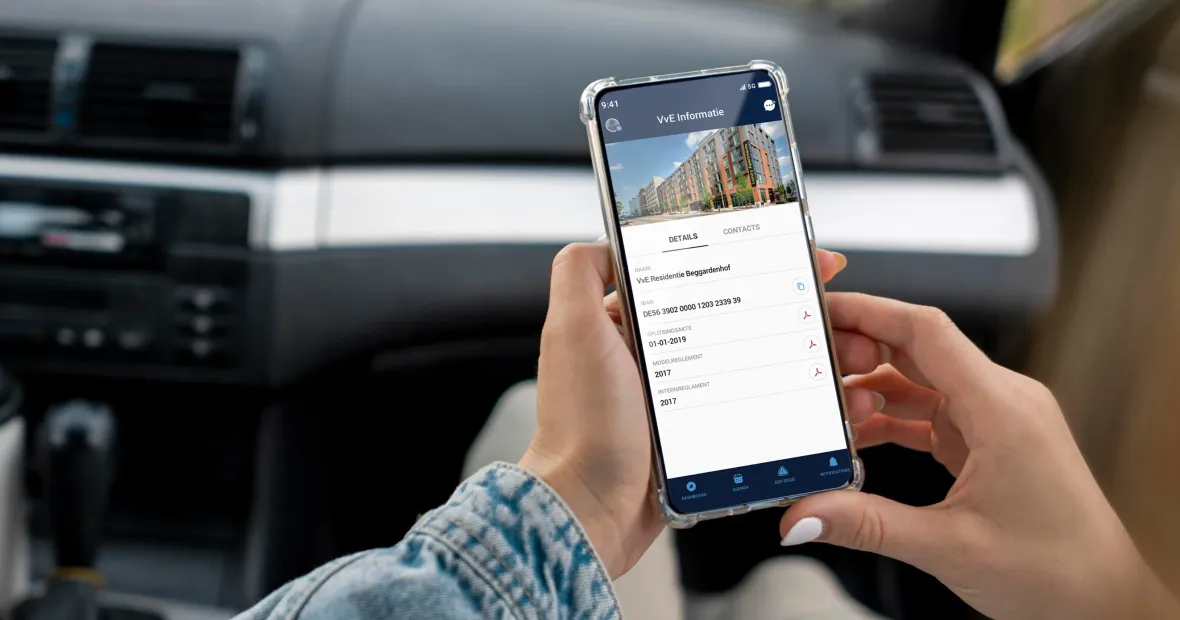
The final product is a robust solution for homeowners to manage their property and communicate with their homeowners’ association (HOA):
- Login and registration. Anyone can register and manage all activity for their place of residence from their device.
- User profile. View and edit personal data, and connect to several HOAs if the user owns apartments in different buildings.
- Invoice management. View invoices and watch their status change in real time.
- In-app chat. Connects all members of an HOA for instant messaging.
- HOA switch. Switch between the associations the user belongs to.
- Company data. View the data of the company the user belongs to.
- Notifications. Alerts for incoming chat messages.
Architecture and tech stack
Java microservices expose a REST API over MariaDB with JPA persistence, built with Maven. A single Angular 11 and Ionic 5 codebase is packaged with Capacitor 2 into native iOS and Android apps.
- Java, REST API, JPA, Maven
- MariaDB
- Microservices on cloud infrastructure
- Angular 11, Ionic 5, Capacitor 2
Results
The client valued the tailor-made application and our ability to meet every deadline. Users now have a convenient tool to communicate with HOA managers and other tenants and to stay up to date with building events.
After launch the client reported:
- A reduction in complaints concerning homeowners’ associations
- Fewer conflicts between associations and tenants
- Fewer late rent payments
- An increase in apartment sales and rentals
- Happier customers
What made it work
Erbis’s takeaways from this engagement:
- Research the culture, not just the requirements. Understanding Dutch multi-family housing shaped a concept the client accepted first time.
- Write the requirements before the wireframes. Seven documented requirement areas gave the designer and developers one shared definition of done.
- One codebase for web, iOS and Android. Angular, Ionic and Capacitor kept a five-person team productive across three platforms.
- Let the analyst own the product. A BA acting as product owner kept decisions close to the client’s business rather than to the backlog.