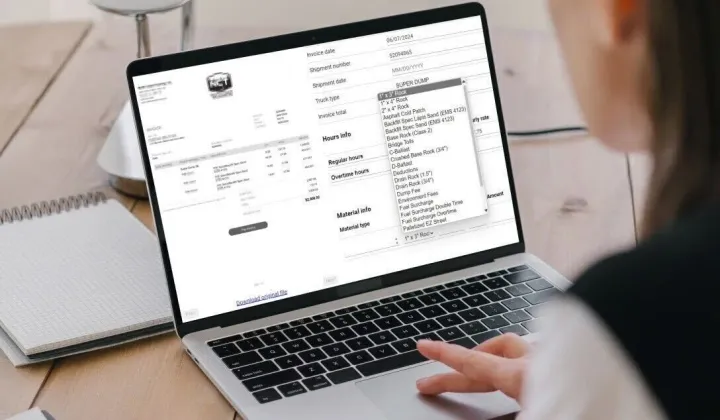
Data & AI Platforms

The data platform your AI needs, built in your own cloud account

Lakehouse on Databricks, warehouse and pipelines on AWS, ML that trains and serves on schedule, and analytics that answer in minutes instead of tomorrow morning. AWS Partner (Select Tier) and Databricks Consulting Partner.

Data & AI Platforms is the Erbis service for building the data foundation AI runs on: Databricks lakehouse, AWS data stacks on Redshift, Glue and SageMaker, near-real-time ETL, ML pipelines and analytics. It is for CTOs and heads of data whose operational data sits in databases, SaaS tools and spreadsheets and who need one governed platform before scaling AI.

faster insights with generative-AI analytics on Redshift and QuickSight Q
60%
less manual reporting for a multi-tenant SaaS
80%
shipments modelled for ETA prediction on SageMaker
304K
production ML on client data since
2017
The problem

Why AI stalls on the data underneath it

Stanford’s 2026 AI Index reports that 88% of organizations use AI in at least one function, but fewer than 10% have fully scaled it in any single function. Gartner names poor data quality first among the reasons 30% of GenAI projects are abandoned after proof of concept. In healthcare, KLAS finds data readiness is the number one barrier to AI. The pattern repeats across industries: the model is ready, the data is not.

Most operational data estates grew by accretion. Orders in one database, transit updates in another, finance in the ERP, customer data in a SaaS tool, and a BI layer refreshed overnight. Analysts reconcile by hand. Data engineers patch pipelines nobody documented. An LLM pointed at that estate answers confidently and wrongly. An ML model trained on it learns the reconciliation errors.

Erbis builds data platforms in the client’s own AWS or Databricks account, so security, cost and compliance stay under your control. We have modelled 304K shipments for ETA prediction on SageMaker, brought data latency down from overnight to minutes with Glue, and delivered generative-AI analytics on Redshift that returned insights 60% faster. We do not run a hosted data product. We build yours, in your account, and hand it over.

What we do

Capabilities

Lakehouse on Databricks

One governed platform for BI, ML and agents, on the lakehouse you already pay for or one we stand up.

  • Medallion architecture (bronze, silver, gold) on Delta Lake
  • Unity Catalog for lineage, access control and data sharing
  • Batch and streaming ingestion from ERP, WMS, TMS and SaaS sources
  • MLflow for experiment tracking and the model registry
  • Migration from Hadoop, on-premises warehouses and legacy Spark

AWS data stack: Redshift, Glue, SageMaker

Warehouse, pipelines and ML on AWS-native services, in your account, under your IAM.

  • Amazon Redshift warehousing with materialized views and row-level security for multi-tenant data
  • AWS Glue ETL and Data Catalog: schema discovery, lineage and metadata for governance
  • Amazon SageMaker for training, endpoints and Ground Truth labelling
  • AWS DMS and Lambda for migration and event-driven processing

Near-real-time ETL and data integration

Operational data in the warehouse in minutes, not the next morning. Structured and unstructured, from streams, databases and third-party APIs.

  • Sources: Amazon RDS, Aurora, Oracle, PostgreSQL, MySQL, SQL Server, on-premises and any JDBC source
  • Incremental updates, schema mapping and type conversion handled in the pipeline
  • Targets: Redshift, Snowflake on AWS, Databricks or any AWS-hosted warehouse
  • Kafka and Flink for event streams where minutes are too slow
  • Pipeline health monitoring so freshness holds as volumes grow

ML pipelines in production

Feature engineering, training, evaluation, deployment and retraining as a pipeline, not a notebook.

  • Feature pipelines: 64 engineered features from raw transit data for shipment-ETA prediction
  • Training and tuning on SageMaker or Databricks: linear models, XGBoost, deep learning where it earns its place
  • Endpoints with auto-shutdown and account-based routing to keep serving cost flat
  • Drift monitoring and scheduled retraining behind evaluation gates
  • Airflow or Databricks Workflows for orchestration

Analytics and generative BI

Dashboards people open and questions people can ask in plain language, embedded where the work happens.

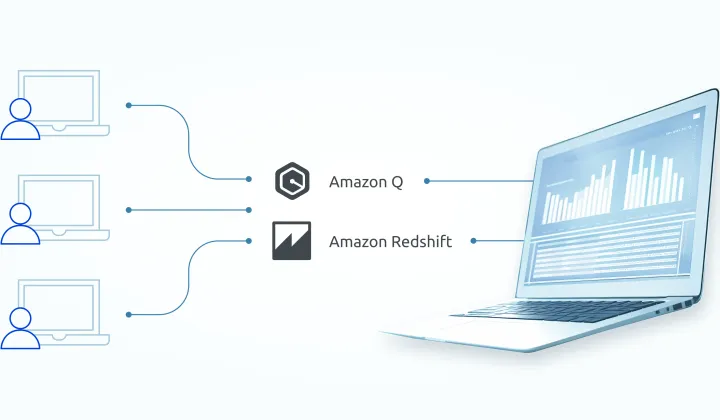
  • Amazon QuickSight with Q for natural-language queries and AI-generated summaries
  • Embedded, tenant-aware dashboards with row-level security and SSO
  • Predictive and real-time analytics on operational data
  • On record: 60% faster insights and 80% less manual reporting for a multi-tenant SaaS

Data foundation for LLMs and agents

The retrieval layer, vector index and access rules that let an agent answer from your data without leaking it.

  • Document pipelines: parsing, chunking, embedding and refresh for RAG
  • Vector search inside the lakehouse or warehouse, not in a separate silo
  • Access control carried from the source system into retrieval
  • Eval datasets built from your own records
  • Cost and latency budgets per query

Data platform audit and optimization

For platforms that already exist: cost, performance, governance and readiness for AI.

  • Warehouse and lakehouse cost review: storage tiering, cluster right-sizing, query tuning
  • Pipeline reliability and freshness audit
  • Governance gap analysis: lineage, PII handling, retention
  • AI-readiness assessment of the estate before a model or agent project starts
In production

How it runs in production

A data platform is judged in month twelve, not at the demo. Four things are in place before handover.

01

Data governance

Catalog, lineage and access control from day one: Unity Catalog on Databricks, Glue Data Catalog on AWS. Row- and column-level security for tenants and roles. PII and PHI classified, masked and retained under written rules. Everything runs in your account under your keys; GDPR, HIPAA and ISO 27001 controls are documented, not assumed.

02

Evaluation and testing

Data quality tests on every pipeline: schema, null rates, referential checks, freshness. ML models carry a held-out test set and a written acceptance threshold; for shipment-ETA prediction that was an RMSE of 21.4 h. Reports and dashboards are reconciled against source systems before release.

03

Observability and cost

Freshness, volume, failure and cost dashboards per pipeline and per table. Warehouse and cluster spend tracked per team with budgets and alerts. Endpoints shut down when idle. You see cost per query and cost per prediction, not one monthly bill.

04

Integration and handover

The platform feeds your BI, your applications and your agents through documented interfaces. Infrastructure is Terraform, pipelines are in your repository, and runbooks cover on-call. Your engineers pair with ours during the build and take over at a date we agree, with support under SLA if you want it.

Proof

What we have built

All case studies

How it works

How we work with you

  1. 01

    Discovery and research

    Two weeks. We inventory sources, volumes, latency needs, consumers and compliance constraints, and decide whether the problem needs a warehouse, a lakehouse, a pipeline or a model. Output: target architecture, cost estimate and a first increment with a metric.

  2. 02

    Data preparation and design

    Ingestion, cleaning and modelling of the datasets the first use case needs. Catalog and access rules set up before data lands. Model architecture or analytics design chosen for the requirement, not the fashion.

  3. 03

    Prototype and experimentation

    A working pipeline, dashboard or model on real data within 2 weeks of build start. Iterated with the people who will use it. Acceptance thresholds tested against a held-out set before anyone calls it done.

  4. 04

    Deployment and continuous optimization

    Production rollout with monitoring, cost controls and runbooks. Retraining schedules, freshness SLAs and quarterly cost reviews. The platform is extended use case by use case rather than rebuilt.

Stack

Technologies we build with

Lakehouse and warehouse

  • Databricks
  • Delta Lake
  • Unity Catalog
  • Amazon Redshift
  • Snowflake on AWS
  • PostgreSQL
  • Amazon RDS and Aurora

Pipelines and streaming

  • AWS Glue
  • AWS DMS
  • Apache Airflow
  • Apache Kafka
  • Apache Flink
  • Hadoop and Spark
  • AWS Lambda

ML and AI

  • Amazon SageMaker
  • MLflow
  • XGBoost
  • Python
  • Amazon Bedrock
  • Anthropic Claude
  • OpenAI
  • Google Gemini

Analytics and access

  • Amazon QuickSight and Q
  • Keycloak
  • AWS IAM and KMS
  • Terraform
  • Kubernetes
FAQ

Data & AI Platforms: questions we get asked

Do we need a data warehouse, a lakehouse, or both?

A warehouse (Redshift, Snowflake) serves structured, SQL-shaped analytics well and is the simpler choice when that is the whole requirement. A lakehouse (Databricks on Delta Lake) adds unstructured data, streaming and ML on the same governed storage, which matters once agents and models are consumers, not just dashboards. Many clients run Redshift for BI and Databricks for ML. We decide in discovery from your sources, consumers and latency needs, not from a preference.

How is data security ensured in big data and AI projects?

The platform runs in your AWS or Databricks account under your IAM and your keys; Erbis engineers work through scoped roles you can revoke. PII and PHI are classified on ingestion, masked or tokenized, and covered by row- and column-level security. Access and lineage are recorded in the catalog. Erbis is ISO 27001 certified and works under DPAs and, for healthcare, BAAs. Nothing leaves your account to be processed elsewhere.

What is the typical timeline for a data and AI platform?

Discovery takes about two weeks and produces a target architecture, a cost estimate and a fixed-price first increment. The first working pipeline, dashboard or model runs on real data within 2 weeks of build start. A first production increment, such as a near-real-time ETL feed into Redshift or an embedded analytics layer, typically takes two to three months. The platform then grows one use case at a time rather than as a multi-year program.

How is a model maintained after deployment?

Every model ships with a held-out test set, an acceptance threshold and a monitoring job that tracks prediction quality and input drift. Retraining runs on a schedule or on a drift trigger, and a new version is promoted only if it passes the same threshold. Endpoint cost is controlled with auto-shutdown and routing. We operate this with your team under an SLA or hand it over with runbooks; the pipelines are in your repository either way.

How much does a data and AI platform cost?

Two costs matter: the build, which we quote as a fixed price per increment after discovery, and the run cost of the cloud services, which we estimate in discovery and track per team once live. Run cost is where platforms go wrong; we design for it with serverless services, idle shutdown, storage tiering and per-query cost visibility. A typical first increment is a two- to three-month engagement. We do not charge a platform license.

Can you work inside our existing Databricks or AWS environment?

Yes, and we prefer it. Erbis is a Databricks Consulting Partner and an AWS Partner at Select Tier, and most engagements extend a platform the client already runs rather than replacing it. We start with an audit of cost, reliability, governance and AI readiness, then build the next increment inside the same account, catalog and CI/CD. Where migration is the right call, such as Hadoop or an on-premises warehouse to the lakehouse, we plan it around a zero-downtime cutover.

Show us the data estate as it is

A source list, a rough volume and the question nobody can answer today. You get a target architecture, a first increment and a fixed price for it.

AWS partner · Databricks partner · ISO 27001 · You own the code from day one