Supply chain & logistics

Build AI-Powered Supply Chain Systems That Predict, Optimize & Scale

Forecasting, routing, tracking and risk models that run inside the TMS, WMS and ERP you already operate, plus agents that handle the exceptions those systems generate. Built by a team that has run a Fortune 500 supply chain platform for more than 10 years.

Erbis builds custom AI supply chain systems for 3PLs, shippers, carriers, warehouses and retailers: demand forecasting, route and load optimization, predictive ETA, warehouse automation, analytics and risk management, integrated with the TMS, WMS, ERP and carrier APIs you already run. Production AI since 2017, 60+ carrier integrations, 99.999% uptime on a Fortune 500 platform.

uptime on a Fortune 500 supply chain platform
99.999%
carrier APIs integrated across 30+ countries
60+
a year saved for one TMS and its customers
$10M+
of clients stay longer than 12 months
89%
The problem

Why most supply chain AI never leaves the pilot

The market has decided. Gartner expects spend on supply chain management software with agentic AI to grow from under $2B in 2025 to $53B by 2030, and 60% of enterprises using SCM software to adopt agentic features in that time. The MHI/Deloitte 2026 Annual Industry Report puts current AI use at 41% of supply chain organizations, up from 30% a year earlier. Your customers are watching: 90% of shippers rank technology capability among the most critical factors in selecting a 3PL (NTT DATA/Penn State 2026 3PL Study).

Deployment is the hard part. Shippers name "deploying AI" as their number one challenge (73%, Inbound Logistics 2026), and BCG found that while about 40% of logistics providers have moved AI beyond pilots, only 10% have embedded it at scale and 13% see measurable financial impact. The cause is rarely the model. It is the TMS with no clean API, the WMS with three years of inconsistent SKU data, the carrier that still speaks EDI, and planners who will not act on a number they cannot trace.

The prize is operational. McKinsey puts AI demand forecasting at 30–50% lower forecast error, with stockouts down as much as 65% and inventory 20–50% lower. Those gains only show up when the forecast writes back into replenishment, the ETA feeds the exception queue and the route plan reaches the driver. That integration work is what Erbis has done in supply chain since 2012, and it is why our AI ships.
What we build

Solutions we deliver

Forecast demand and automate replenishment

AI-powered demand forecasting on your own order, inventory and market history. Models handle promotions, seasonality and new-SKU cold starts, and write recommended orders back into the ERP or IMS so replenishment runs without a spreadsheet.

  • Multi-variable time-series models across SKUs, locations and channels
  • Seasonal, promotional and lead-time patterns learned from your history
  • Real-time data integration from ERP, POS, IMS and supplier feeds
  • Replenishment agents that raise purchase orders within your approval limits
  • Forecast accuracy tracked per SKU and reported against your current baseline

See margin, fraud and rate leakage in real time

Advanced AI-driven analytics that aggregate shipment, invoice and carrier data across systems and surface what a dashboard alone cannot: duplicate charges, off-contract rates, anomalous carrier invoices and cost per shipment by lane.

  • Real-time aggregation from TMS, WMS, ERP and carrier invoices
  • Fraud and anomaly detection on carrier billing and claims
  • Shipping rate optimization against contracted and spot rates
  • Operational dashboards with natural-language questions for planners
  • Cost-control alerts with the underlying records attached

Automate the warehouse without replacing the WMS

Intelligent warehouse automation layered on your existing WMS: real-time inventory, IoT and scanner integration, slotting and labor optimization, and workflows that release work to people and robots in the right order.

  • Real-time inventory tracking across zones, bins and returns
  • IoT, RFID and scanner integration for location-level accuracy
  • Automated workflows for receiving, putaway, picking and packing
  • Warehouse optimization: slotting, wave planning and labor allocation
  • Integration with existing WMS, OMS and ERP through their native APIs

Plan routes and loads that hold up on the road

AI-optimized route planning that accounts for time windows, vehicle constraints, live traffic and multi-modal legs, with dynamic load planning that re-plans when an order changes at 6 a.m. and an agent that tells the carrier.

  • Route optimization algorithms tuned to your fleet and service levels
  • Dynamic load planning as orders, cancellations and capacity change
  • Real-time traffic and weather inputs for re-routing in transit
  • Multi-modal planning across road, rail, air and ocean legs
  • Cost-efficient routing measured in cost per stop and empty miles

Predict ETAs and clear exceptions before customers call

Real-time tracking with predictive ETA trained on your own lanes. Erbis modeled 304,441 shipments across 60+ international lanes for a global equipment manufacturer and reached an ETA error (RMSE) of 21.4 hours. Exception agents then act on the prediction.

  • Real-time monitoring across carriers, modes and transit statuses
  • Predictive ETA models trained on your historical lanes and service levels
  • Exception alerts with an agent that drafts the customer and carrier update
  • Multi-carrier integration: DHL, FedEx, USPS, DPD, UPS and regional carriers
  • End-to-end visibility from purchase order to proof of delivery

Manage risk and respond to disruption

AI-powered risk management that scores suppliers, lanes and carriers, predicts disruption from weather, port and geopolitical signals, and gives your team a ranked mitigation plan instead of a red dashboard.

  • Predictive risk assessment for suppliers, lanes and single points of failure
  • Disruption prediction from weather, port congestion and news signals
  • Real-time alerts routed to the owner with recommended actions
  • Supplier performance analytics on OTIF, lead time and quality
  • Mitigation playbooks that agents execute within your approval limits
In production

How AI fits the systems you already run

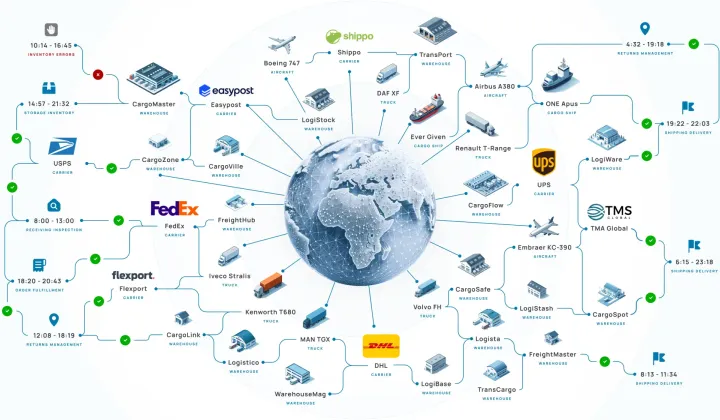
Erbis has built and integrated TMS, FMS, ELD, ERP, IMS, WMS and OMS platforms since 2012, with 4,000+ system integrations completed. AI is a layer on that foundation: models that read from and write to your systems, and agents that handle exceptions, carrier communication, replenishment and procurement orchestration across them, with a person approving anything outside policy.

01

Integration map

TMS (routing, tendering, tracking), WMS (inventory, tasks), OMS (orders, returns), ERP (purchasing, finance), FMS and ELD (fleet, hours of service), payment gateways, IoT and telematics, mapping APIs, and carrier APIs including DHL, FedEx, USPS, DPD and UPS. Erbis has integrated 60+ carriers over EDI, SOAP and REST for one TMS alone, so the adapter layer, status polling and error interpretation already exist.

02

Data governance

Shipment, rate and customer data stays in your accounts: AWS, Databricks, Azure or on-premises. Erbis is ISO 27001 certified and builds role-based access, audit logs and data retention into every system. Where customer or driver data is involved, the design covers GDPR and, for ELD work, the hours-of-service rules the device must satisfy.

03

Evaluation and human-in-the-loop

Every model ships with an evaluation set built from your own history and a baseline to beat: your current forecast, the carrier-provided ETA, the planner's route. Agents act inside explicit limits (order value, carrier, lane) and escalate outside them. Confidence thresholds route low-confidence cases to a reviewer, the pattern that gives Erbis invoice automation ~95% straight-through processing.

04

Run and support

The system is monitored in production: model drift, integration failures, agent actions and cost per decision. Erbis has run one Fortune 500 supply chain platform for more than 10 years at 99.999% uptime. Code and models are yours from day one; 89% of clients stay longer than 12 months because the system keeps improving, not because they are locked in.

Proof

What we have built

All case studies

How it works

How we work with you

  1. 01

    Discovery and strategy

    Two to three weeks. We map your systems, data and the operating metric that has to move (OTIF, cost per shipment, forecast error, dock-to-stock time), then pick the first use case with a measurable baseline and a go/no-go criterion.

  2. 02

    Custom AI development and design

    Models and agents built on your data, with the interface your planners and dispatchers will use. Something working is on screen within 2 weeks of the start; a production-grade pilot is typically ready in 4.

  3. 03

    Integration and testing

    Connect to TMS, WMS, ERP and carrier APIs through their native interfaces, test against sandboxes we build when the carrier has none, and run the model on live data in shadow mode until it beats the baseline.

  4. 04

    Deployment and ongoing support

    Roll out by lane, site or customer. Erbis monitors, retrains and extends the system, adds carriers as your network grows, and hands over documentation, code and runbooks at every phase.

Stack

Systems and technologies we work in

Supply chain systems we build, extend and integrate

  • TMS
  • FMS
  • ELD
  • ERP
  • IMS
  • WMS
  • OMS
  • SAP
  • Oracle
  • Microsoft Dynamics 365
  • NetSuite

Carriers and protocols

  • DHL
  • FedEx
  • USPS
  • DPD
  • UPS
  • C.H. Robinson
  • Flexport
  • DSV
  • EDI
  • SOAP
  • REST
  • XML

AI and ML

  • Amazon SageMaker
  • Amazon Bedrock
  • Databricks
  • XGBoost
  • PyTorch
  • Google OR-Tools
  • Anthropic Claude
  • OpenAI
  • Google Gemini
  • LangGraph

Data and infrastructure

  • AWS Lambda
  • Amazon Redshift
  • AWS Glue
  • Amazon QuickSight
  • Apache Airflow
  • PostgreSQL
  • Keycloak
  • Kubernetes
  • Terraform
FAQ

Supply Chain & Logistics: questions we get asked

What types of AI supply chain systems does Erbis build?

Demand forecasting and replenishment, route and load optimization, predictive ETA and real-time tracking, warehouse automation on top of your WMS, supply chain analytics with fraud and rate-leakage detection, and risk management. Underneath, we build and modernize the core systems themselves: TMS, FMS, ELD, ERP, IMS, WMS and OMS. On top, we add agents that handle exceptions, carrier communication, replenishment and procurement orchestration across those systems.

How long does it take to build an AI supply chain system?

You see something working within 2 weeks. A production-grade pilot on one use case, with a measured result against your baseline, typically takes 4 weeks. Full rollout depends on the number of systems and sites: a predictive ETA service integrated with an existing TMS is a matter of months; a multi-site warehouse automation program is phased over quarters. Each phase has an exit point.

Can you integrate with our existing TMS, WMS, ERP and carriers?

Yes. Integration is most of the work and it is where Erbis has the deepest record: 4,000+ integrations completed, including 60+ carrier APIs (DHL, FedEx, USPS, DPD, UPS and regional carriers) across 30+ countries for a single TMS, over EDI, SOAP and REST. We also connect payment gateways, IoT and telematics devices and mapping APIs, and we build test environments for carriers that do not provide one.

What makes Erbis different from other AI development companies?

Supply chain is our deepest industry, not a page added in 2023. We have built software since 2012 and production AI since 2017, run a Fortune 500 supply chain platform for more than 10 years at 99.999% uptime, and 89% of clients stay longer than 12 months. Everything is custom-built on your infrastructure, integrated end to end with ERPs, TMS, WMS, payment gateways, IoT, mapping APIs and carriers, and delivered in an agile cadence with something to show every 2 weeks.

What types of companies do you work with?

Logistics companies and 3PLs, last-mile delivery operators, warehouses and fulfilment providers, eCommerce and retail supply chains, rail and air freight, and road transport and commercial vehicle fleets. Most are mid-market and enterprise operations with real data, systems that off-the-shelf tools have started to fail, and a supply chain SaaS or in-house platform they need to extend with AI.

Do you provide ongoing support after deployment?

Yes. Models drift, carriers change their APIs without notice, and volumes grow. Erbis monitors the system in production, retrains models on new data, adds carriers and integrations as your network changes, and keeps the runbooks current. Support is a phase with its own terms, and you keep code ownership and documentation whether you stay with us or take it in-house.

Pick the operating metric you want to move

A 45-minute discovery call to map your systems and choose the first use case with a measurable baseline. Something working within 2 weeks; a go/no-go decision in 4.

AWS partner · Databricks partner · ISO 27001 · You own the code from day one