8 Must-Have TMS Features in 2026 (and Where AI Agents Fit)
The eight transportation management system features that matter in 2026: load planning, tracking, carrier and WMS integration, analytics, freight audit, route optimization and mobile, and where AI agents now change each one.

A transportation management system (TMS) plans loads, books carriers, tracks shipments, audits freight invoices and reports on cost per shipment. In 2026 the feature list has not changed much. What has changed is how each feature works: machine learning now predicts travel times, large language models read carrier invoices, and agents handle the exceptions that used to land in a planner’s inbox.
This guide covers the eight features every TMS needs, what each one does behind the scenes, and where AI changes the picture. It is written for operations and technology leaders who are buying, replacing or extending a TMS.
What a TMS has to do in 2026
Most logistics providers already run a TMS. In the Inbound Logistics 3PL Perspectives 2026 survey, 87% of third-party logistics providers have a TMS in their stack, ahead of visibility platforms (83%) and WMS or WES (72%). The same survey found the number one challenge shippers name is deploying AI (73%).
The gap between owning AI and running it is wide. BCG and Alpega surveyed 182 logistics providers and shippers in January 2026: about 40% of providers had deployed AI beyond pilots, but only 10% had embedded it at scale and only 13% saw measurable financial impact. Transport planning, execution and route optimization was the top priority for 64% of providers.
The direction of travel is clear. Gartner forecasts (April 2026) that spending on supply chain management software with agentic AI grows from under $2B in 2025 to $53B in 2030, and that 60% of enterprises using SCM software will have adopted agentic features by 2030, up from 5% in 2025.
So the question for a TMS in 2026 is not whether it has the eight features below. It is whether each feature can take in live data, make a decision and act on it with the right level of human oversight.
1. Load planning and optimization
Load planning groups shipments into loads or trailers in the most efficient way. It cuts empty miles, improves trailer utilization and shortens delivery times.
Here is how it works in a TMS:
- The TMS identifies similar destinations and consolidates shipments.
- It checks weight limits and volume capacity per vehicle and sorts shipments accordingly.
- It uses 3D cubing algorithms to decide how to stack goods within a trailer.
- It separates shipments with special requirements, such as temperature or humidity, and proposes the right equipment.
- It compares shipment size and weight against rates and recommends Less-Than-Truckload (LTL) or Full-Truckload (FTL).
What AI adds. Classic load planners run on fixed rules and static rate tables. A machine-learning model trained on your own historical loads learns which consolidations actually held up in practice: which lanes run late, which customers refuse partial deliveries, which dock slots are always contested. The planner then optimizes against predicted outcomes, not just theoretical capacity.
Want to cut transportation costs? Talk to an Erbis engineer.
2. Real-time shipment tracking
Real-time tracking shows where each vehicle and load is right now and updates delivery status without a phone call. It also helps handle breakdowns: a defective vehicle can be routed to the nearest service center and, if the repair will take long, a second truck can be dispatched to pick up the stranded cargo.
Tracking supports compliance as well. Because driving time is recorded, you can plan against the hours-of-service limits set by the FMCSA (Federal Motor Carrier Safety Administration).
To implement tracking in a TMS you need to:
- Equip vehicles with GPS or telematics devices.
- Transmit data over cellular or satellite networks.
- Process it with stream-processing frameworks, time-series storage and a messaging layer.
- Choose a mapping library. Google Maps is the most common choice.
- Implement alerts and notifications based on predefined conditions.
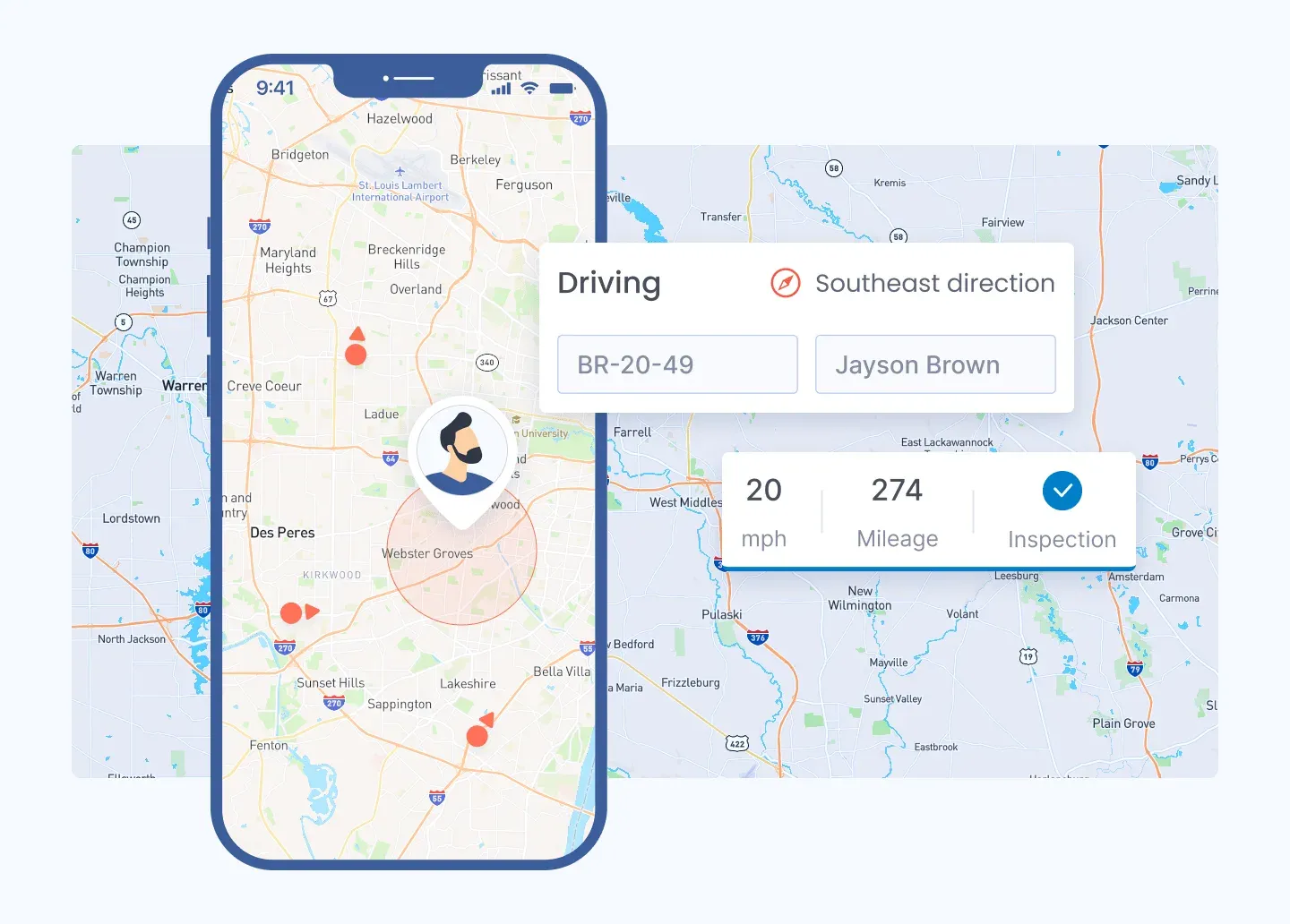
What AI adds. Position data on its own answers “where is it”. Predictive ETA answers “when will it arrive”, which is the question customers actually ask. A model trained on historical shipments, carrier performance, weather and traffic predicts arrival times and flags the shipments that will miss their window while there is still time to act. Erbis built one such model on 304,000 shipments; it predicts arrival with a root-mean-square error of 21.4 hours on multi-day freight. Gartner treats predictive ETA as an essential feature of real-time transportation visibility platforms.
3. Integration with multiple carriers
A TMS connects to trucking companies, shipping lines, airlines, railroads and parcel carriers so users can compare rates, transit times and service levels, then book in one place. With a rating engine in place the TMS can suggest the best option automatically. If an e-commerce customer places an order, the TMS calculates the cheapest and fastest delivery options and shows both.
To implement carrier integrations you need to:
- Build an API layer through which the TMS talks to each carrier.
- Secure data exchange with encryption and access controls.
- Map data fields between your TMS and each external system.
- Store responses in your database or forward them for analysis.
- Implement error handling so a failed call does not block a shipment.
The hard part is scale. Integrating one carrier is straightforward. At 10, 50 or 100 carriers you are dealing with EDI, SOAP, REST and XML side by side, undocumented data models, unannounced API changes and rate limits. Erbis integrated and maintains 60+ carrier APIs across 30+ countries for a global TMS used by Fortune 500 shippers, including DHL, FedEx, UPS, USPS and DPD. The platform shows shipment status with under one minute of delay and has optimized $10M+ a year in shipping costs for the client and its customers.
What AI adds. Two things. First, an LLM can read carrier documentation and error messages and translate them into plain language for users, which cuts support tickets. Second, a carrier-selection agent can score each shipment against contracted rates, on-time history, damage rates and capacity, and book the carrier automatically within limits you set, escalating anything outside them.
4. Integration with WMS
A warehouse management system (WMS) manages inventory, stock locations and picking. Together, WMS and TMS cover the full path from a supplier’s dock to a customer’s door.
Take a manufacturer that works with several spare-parts suppliers. Production needs parts in stock, but the warehouse should not be overloaded. The TMS proposes shipping routes and dates from suppliers to the warehouse; the WMS adjusts stock levels as parts arrive and as they leave for the production line. Neither system can do that alone.
The integration itself follows the same pattern as carrier integration: an API, secure transfer and a shared data model for orders, shipments and locations. For the warehouse side of the equation, see our guide to reducing warehouse operating costs with AI-driven WMS and the supply chain and logistics work Erbis has done in production.
5. Analytics and reporting
Analytics shows what worked and what did not. In a custom TMS you decide which reports exist and which indicators appear on them. Typical reports cover shipments, inventory, route efficiency and cost analysis, and track:
- carrier performance
- shipment history
- route efficiency
- inventory levels and turnover
- cost per mile or kilometer
- cost allocated to specific products or customers
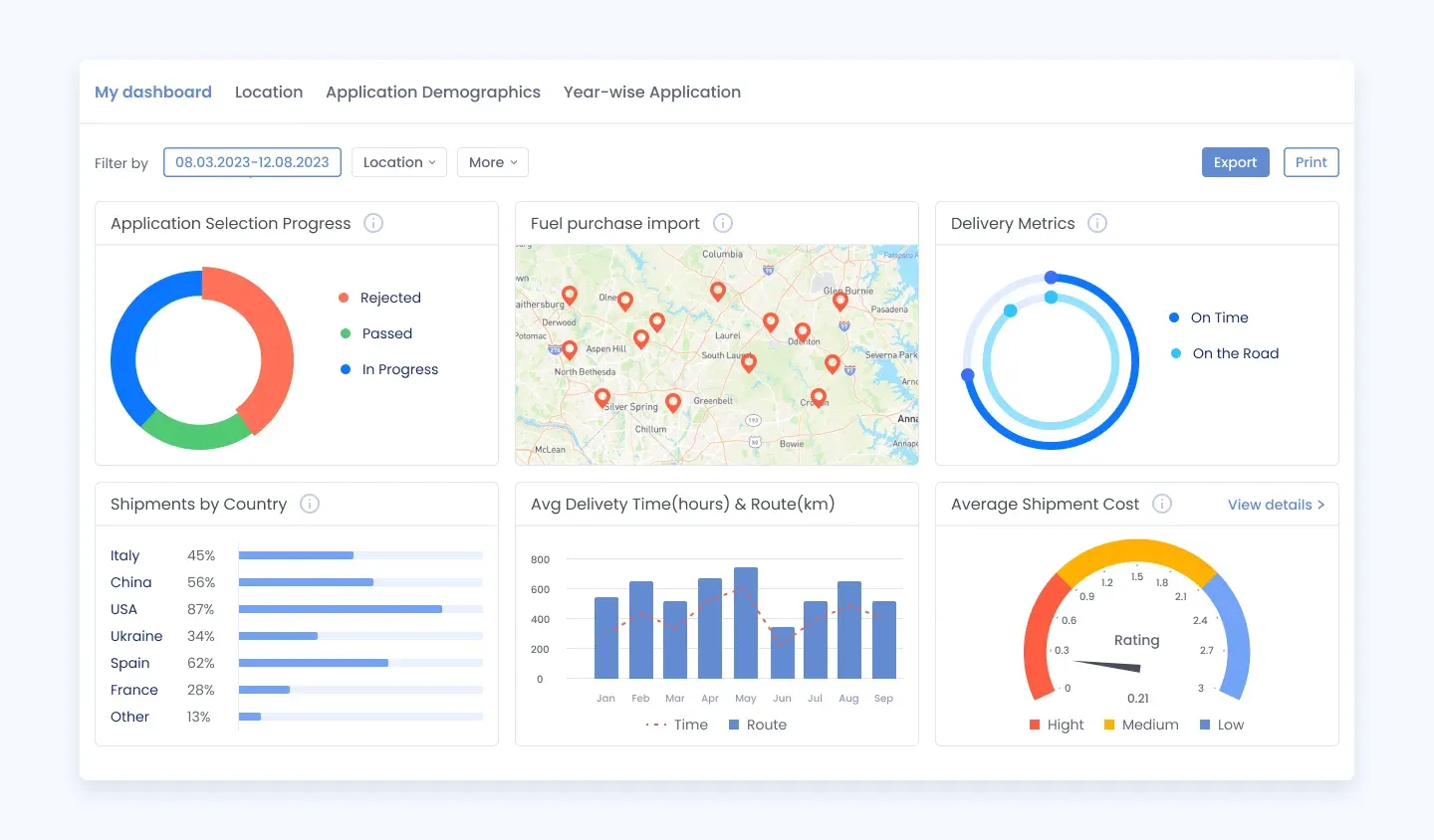
What AI adds. Dashboards describe. AI models on a data and AI platform predict and prescribe: which lanes will overrun budget next month, which carrier is drifting on on-time performance, which customers generate the most accessorial charges. An LLM interface lets a planner ask “why did cost per shipment on the Chicago lane rise in August” and get an answer built from the data rather than a filtered table.
6. Freight audit and payment automation
Freight audit and payment (FAP) automation removes manual invoice reconciliation. It saves time, cuts errors and gives finance a controlled approval path.
Here is how the pipeline works:
Invoice capture. Invoices arrive through Electronic Data Interchange (EDI), email or API. Paper and scanned invoices are digitized.
Data extraction. The TMS pulls shipment details, carrier charges, accessorial fees and references from each invoice.
Data validation. The system checks:
- rates: whether carrier charges match negotiated rates
- shipment information: whether invoice details match the shipment record in the TMS
- surcharges and accessorials: whether each one is contractually documented
Discrepancy detection. Incorrect charges, duplicate invoices, missing documentation or terms that do not match the contract.
Exception handling. Discrepancies generate alerts routed to the responsible person.
Approval workflow. Approved invoices move automatically to the right department or approver.
Payment processing. Once approved, the system initiates payment.
What AI adds. The capture and extraction steps used to depend on optical character recognition (OCR) with a template per carrier. Templates break whenever a carrier changes its layout. LLM-based document extraction reads the invoice the way a person does, so a new format or a handwritten note does not stop the line. Erbis runs this pattern in production: an AI invoice-processing pipeline digitizes about 95% of invoices without human intervention, cut manual work 15x and saves $10M+ a year across the 10+ companies using it. Invoices below a confidence threshold go to a human reviewer, and every correction feeds back into the model.
The exception-handling step is where an agent earns its place. A freight audit agent can read the discrepancy, pull the contract clause and the shipment record, draft a dispute to the carrier and post the case to the approver with the evidence attached. Humans still approve. They stop doing the research.
7. Route optimization
Route optimization is one of the most requested TMS capabilities. It proposes the best path from A to B, taking into account:
- transport type
- road type
- cargo type
- expected delivery time
- weather conditions
- traffic conditions
Good route optimization reduces transport costs, protects delivery windows, loads trucks better, reduces weather-related failures and improves service quality.
Here is how it works in a TMS:
- The TMS collects data on shipments, delivery locations and vehicle availability.
- The routing algorithm evaluates route options, including alternative routes and stops.
- Constraints are applied, such as delivery time windows and driver hours.
- The TMS monitors traffic and road closures and adjusts routes.
- Route updates are pushed to drivers and customers throughout the journey.
What AI adds. Three things change with AI route optimization. Travel-time estimates come from a model trained on your own lanes rather than from a static speed table. Re-planning happens continuously as new orders, cancellations and delays arrive, instead of once in the morning. And a dispatch agent can act on a disruption: re-sequence stops, notify the customers whose windows moved and request a driver swap, all within rules the operations team defined. Gartner predicts that by 2031, 60% of supply chain disruptions will be resolved without human intervention. Route and dispatch decisions are where that starts.
Ready to streamline your routes? Explore what a custom TMS could do for you.
8. Mobile app
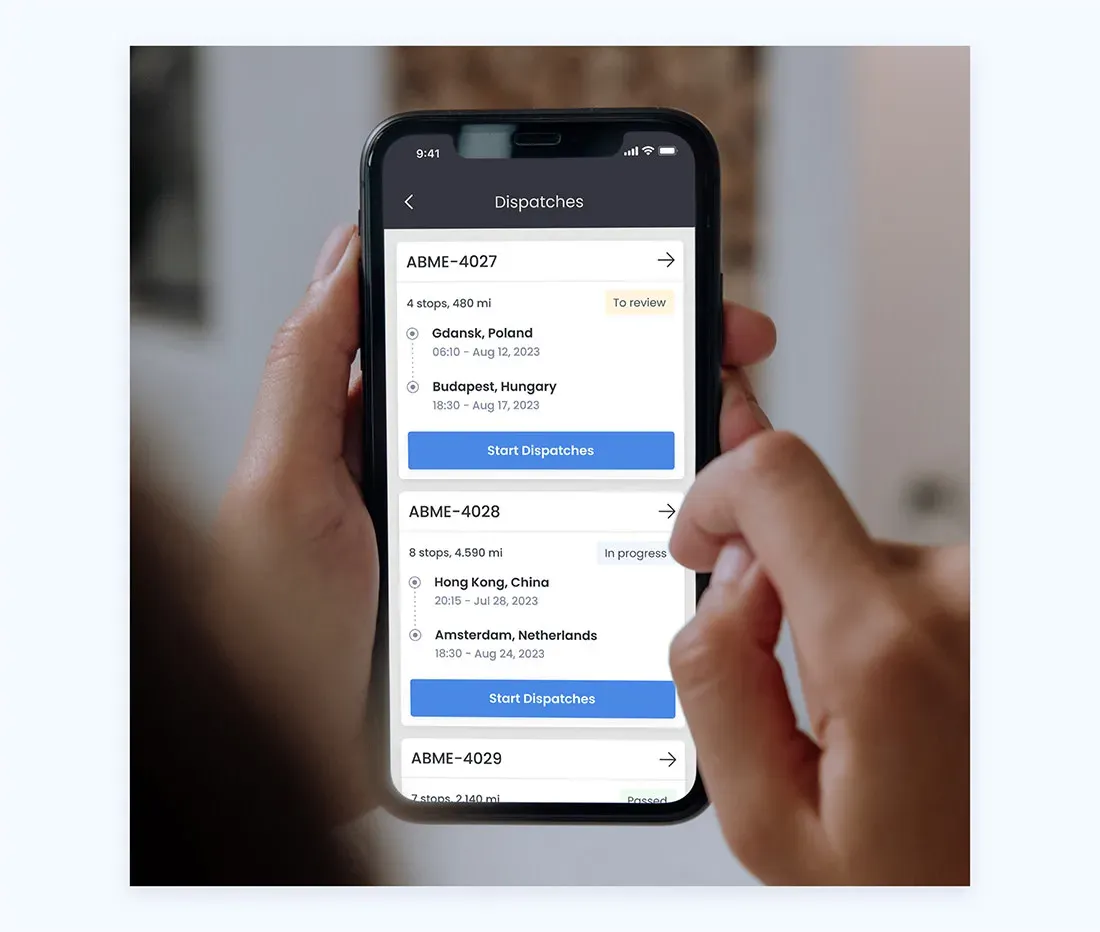
Drivers and field staff need the TMS on a phone: current load, next stop, route changes, proof of delivery and a way to report a problem. Dispatchers need to react to critical situations from wherever they are.
We recommend building the web TMS first and the mobile app second. A web interface handles complex planning work that needs a large screen, and it suits collaborative use where several planners work in the same system at once. Mobile then extends the parts of the system that matter on the road.
Where AI agents fit in a TMS
Three agents pay for themselves fastest in a TMS. Each one sits on top of the features above rather than replacing them.
Route and dispatch agent. Watches ETAs, traffic and order changes; re-plans routes; notifies customers; escalates when a rule is breached (for example, a cold-chain shipment predicted to arrive more than two hours late).
Freight audit agent. Reads invoices, matches them to contracts and shipments, drafts disputes and prepares the approval package.
Exception-handling agent. Monitors carrier API errors, failed EDI messages, missing documents and unconfirmed pickups; fixes what it is allowed to fix (retries, data corrections, re-sends) and hands the rest to a person with the context attached.
All three need the same engineering foundation: guardrails on what the agent may change, an evaluation set to measure decisions before and after release, logging of every action, and integration with the TMS, ERP and carrier systems that hold the data. That is the work of agentic AI engineering, and it is the difference between a demo and something operations will trust. If you want to test one agent on live data before committing, a 4-week AI pilot is the shortest path to a go or no-go decision.
How Erbis can help with TMS development
Erbis has built software since 2012 and has run AI in production since 2017. Our 200 engineers have completed 4,000+ system integrations, and 89% of our clients stay with us for more than 12 months.
In transportation specifically, we re-architected a supply chain management platform for a San Francisco logistics company into microservices on AWS, with carrier rate comparison and self-service portals used by Fortune 500 shippers. We integrated 60+ carriers across 30+ countries for a global TMS. And we built the AI invoice pipeline described above, which now runs at more than 10 companies.
If you are building a TMS, replacing one, or adding AI to the one you have, contact us. We will look at your systems and data and tell you what is realistic in 4 weeks, in 6 months and not at all.
FAQ
Do you have a proven track record of developing TMS?
Yes. Erbis has delivered several TMS and supply chain projects, including the re-architecture of a transportation management platform for a logistics provider in San Francisco and the integration of 60+ carrier APIs for a global TMS used by Fortune 500 shippers.
How much does it cost to develop a TMS?
It depends on scope, integrations, scalability requirements and the team’s rates. A basic TMS starts at around $50,000. A comprehensive, custom-built system for a large enterprise with dozens of carrier integrations and AI-driven planning can run into millions of dollars. A fixed-fee pilot on one feature is the cheapest way to get an accurate estimate for the rest.
Can a TMS support eco-friendly logistics?
Yes. Route optimization, load consolidation and fewer empty miles cut fuel consumption and emissions directly. A TMS can also report emissions per shipment, which many shippers now require from their carriers and 3PLs.
Do I need AI agents in my TMS, or is a rules engine enough?
Start with the rules. A rules engine handles the cases you can describe in advance. Agents earn their place where the cases vary: invoice disputes, disruption response, carrier errors. If your planners spend most of their day on exceptions, that is the signal to pilot an agent on that queue first.