How AI-Driven Warehouse Management Cuts Operating Costs
Where warehouse operating costs come from and how a WMS with AI slotting, labor forecasting, agentic replenishment and computer-vision inventory counts removes them. Practical levers first, AI second.
Warehouse operating costs come down in two stages. First, fix the physical and process basics: layout, storage addressing, storage conditions and a logistics audit. Second, put a warehouse management system (WMS) in place and add the AI capabilities that now do the planning work people used to do by hand: slotting, labor forecasting, replenishment and inventory counting.
This guide covers both stages. It keeps the practical levers that have always worked and adds what changed in 2026: machine learning on your own order history, computer vision on the floor and agents that place replenishment orders inside rules you set.
Where warehouse operating costs come from
Remember when the business fit into one room with a few boxes? An Excel sheet was enough for SKU management, and stock was updated by hand. As the business grew, so did the building, the headcount and the number of ways to lose money.
Five cost lines dominate most warehouse budgets:
- Labor. Picking, packing, receiving and put-away. Usually the largest line and the most sensitive to layout and slotting.
- Space. Rent or depreciation per square meter, plus the cost of the space that is occupied by slow-moving or dead stock.
- Inventory carrying cost. Capital tied up, insurance, shrinkage and obsolescence.
- Errors and returns. Mis-picks, mis-ships and inventory records that do not match the shelf.
- Equipment and energy. Forklifts, conveyors, climate control.
The pressure is rising. In the Inbound Logistics 3PL Perspectives 2026 survey, 66% of logistics providers named rising operational costs as their top concern, and 52% named capacity, up from 31% the year before. Yet automation is still far from universal: vendor-sourced estimates put the share of automated warehouses at roughly 25%, with 87% of decision-makers planning to expand automation. Interact Analysis reports warehouse automation order intake grew 7% in 2025 with 6% forecast for 2026.
Warehouse management best practices that cut costs
Warehouse management and WMS software are not the same thing. The WMS automates and improves processes that already exist. If the underlying process is chaotic, the software will automate the chaos. So start with the process.
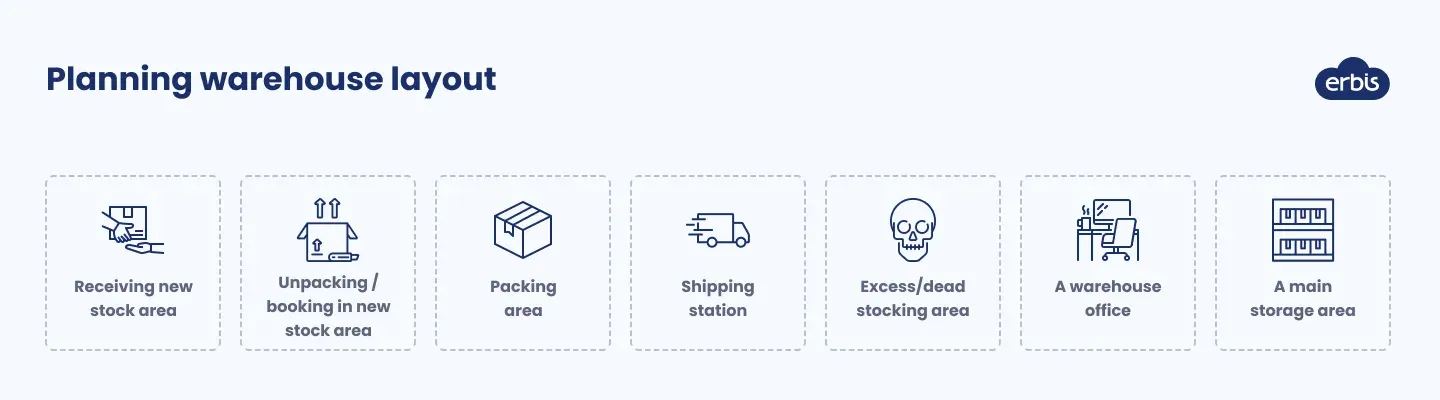
Planned warehouse layout
Layout depends on the goods, the floor area and the number of staff. You need enough space for storing, sorting and packing, room for equipment and people to move, and an office zone where staff work on computers. The zones below are the minimum for most operations.
Address storage system
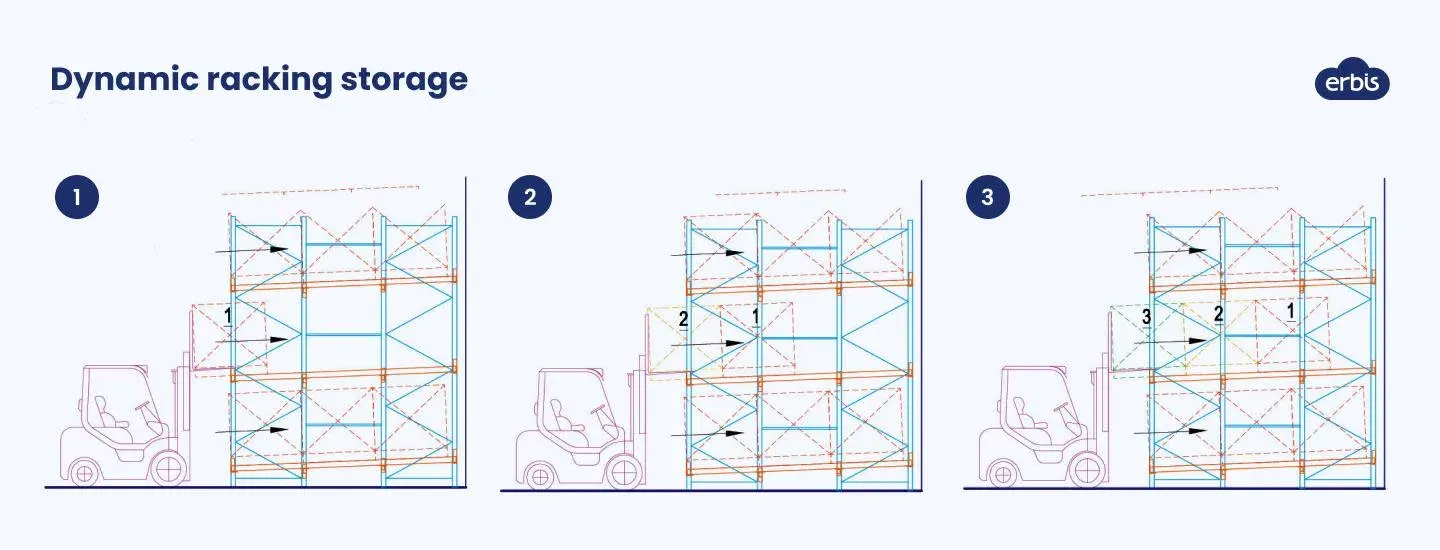
You can use static or dynamic address storage.
A static system gives each product a fixed place. It suits smaller businesses with moderate flows, and it works even with manual picking because staff remember where things are.
A dynamic system fills any empty cell with incoming goods. It suits organizations with a wide product range, a changing assortment and batch accounting. It is more complex and needs software and scanning equipment to record and read locations, but it uses space far better.
Product preservation environment
Storage conditions are a cost lever because spoiled or damaged stock is pure loss.
- Food typically needs 5 °C so it reaches the distributor in proper condition.
- Clothing needs humidity between 50% and 70% and protection from direct sunlight.
- Indoor plants need a constant 18–20 °C.
This takes climate equipment and a monitoring system that alerts you when conditions leave the normal range. In 2026 that monitoring is usually IoT sensors feeding the WMS, so an out-of-range reading creates a task rather than an email nobody reads.
Logistics audit
Before investing, analyze the current logistics system and find the changes that suit the business. If the expertise is not in-house, bring in a logistics consultant. Assess:
- specifics of goods
- warehouse space and location
- building materials and security
- available shipping providers
- customer expectations
- human resources
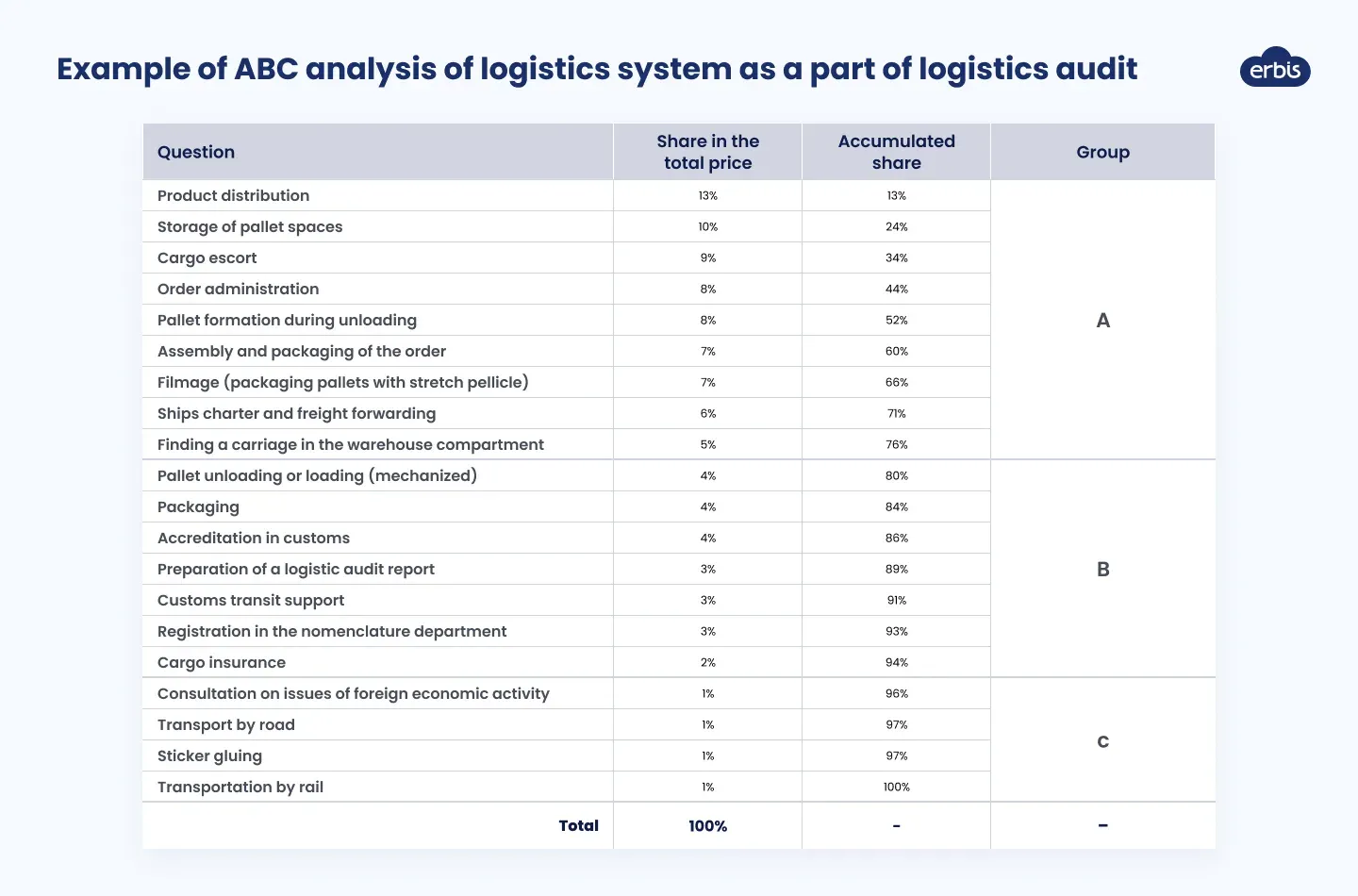
One useful output is an ABC analysis of where the money goes. Group A activities are the ones to automate first.
Business-tied WMS
Choose the WMS based on the audit, not the demo. There are many solutions, from simple apps to enterprise systems. If nothing fits, or the fit costs more than it saves, custom WMS development gives you a system tied 100% to how your warehouse actually runs.
Five AI capabilities that cut warehouse costs
With the basics in place, AI attacks the five cost lines directly. None of these require a new WMS. They need a WMS with clean data and an integration layer, which we cover in the next section.
AI slotting
Slotting decides which SKU lives in which location. Done by hand, it is revisited once or twice a year. Done by a model, it is revisited continuously, using order history, SKU velocity, item dimensions, weight, affinity between items ordered together and seasonality. Fast movers migrate toward the packing station; items that ship together sit near each other; heavy items go low. The result is shorter pick paths and fewer touches per order, which is the biggest single lever on labor cost.
Labor forecasting and shift planning
A labor model predicts order volume by hour and by zone from sales forecasts, promotions, carrier cut-offs and historical patterns, then converts it into required headcount per shift. Supervisors see tomorrow’s staffing gap today instead of discovering it at 07:00. Overtime falls, temp labor is booked earlier and cheaper, and idle time in slow hours goes down.
Agentic replenishment
A replenishment agent watches stock levels, forecast demand, supplier lead times and minimum order quantities, and raises purchase or transfer orders when a reorder point is reached. It runs inside rules the planner sets: budget per order, approved suppliers, exceptions that always go to a human. Compared with a weekly review, it reacts in hours and holds less safety stock. McKinsey’s work on AI demand forecasting reports 30–50% lower forecast error, up to 65% fewer stockouts and 20–50% lower inventory. Replenishment is where those forecasts turn into cash.
Computer-vision inventory counts
Cameras on forklifts, fixed cameras over racks, or drones flying the aisles after hours read labels and count pallets and cases. The counts reconcile against the WMS record automatically. Cycle counting stops being a weekly task for two people and becomes a continuous check that flags a discrepancy the day it appears. Shrinkage, mis-slots and phantom stock get caught before they cause a mis-ship.
Demand forecasting
Every capability above depends on a forecast. A demand model on a data and AI platform uses your own order history, promotions, weather and calendar effects, and produces a forecast per SKU per location per day. ABI Research found that 91% of supply chain organizations plan to use AI for demand forecasting within two years. The forecast is the shared input to slotting, labor and replenishment, which is why we build it first.
WMS integration: where savings are made or lost
AI in a warehouse fails for a boring reason: the data is stuck in systems that do not talk to each other. The order forecast sits in the ERP, the stock record in the WMS, the carrier cut-off in the TMS and the sensor data in a vendor cloud. A model that cannot read all four makes bad decisions.
The integration layer a warehouse needs in 2026:
- ERP. Purchase orders, sales orders, item master, costs.
- TMS. Carrier bookings, pickup windows and dock scheduling. See our guide to must-have TMS features.
- IoT and equipment. Sensors, scanners, conveyors, robots and cameras.
- Carriers and marketplaces. Labels, tracking, returns.
- Finance. Invoices and freight audit, where LLM-based document extraction now replaces template OCR.
Legacy systems are the usual blocker. Gartner expects SCM software without agentic features to lose ground, and warns that legacy systems without those features will increasingly fail to meet customer requirements. In practice you do not need to rip out the WMS; you need an integration and orchestration layer around it. That is the core of our AI automation and integration work, and it draws on the 4,000+ integrations Erbis engineers have delivered. For the wider picture, see our overview of supply chain automation.
Risks to plan for when implementing a WMS
A WMS is a large investment and a proven way to reduce warehouse operating costs over time. Assessing the risks up front is what keeps the project pointed at that outcome.
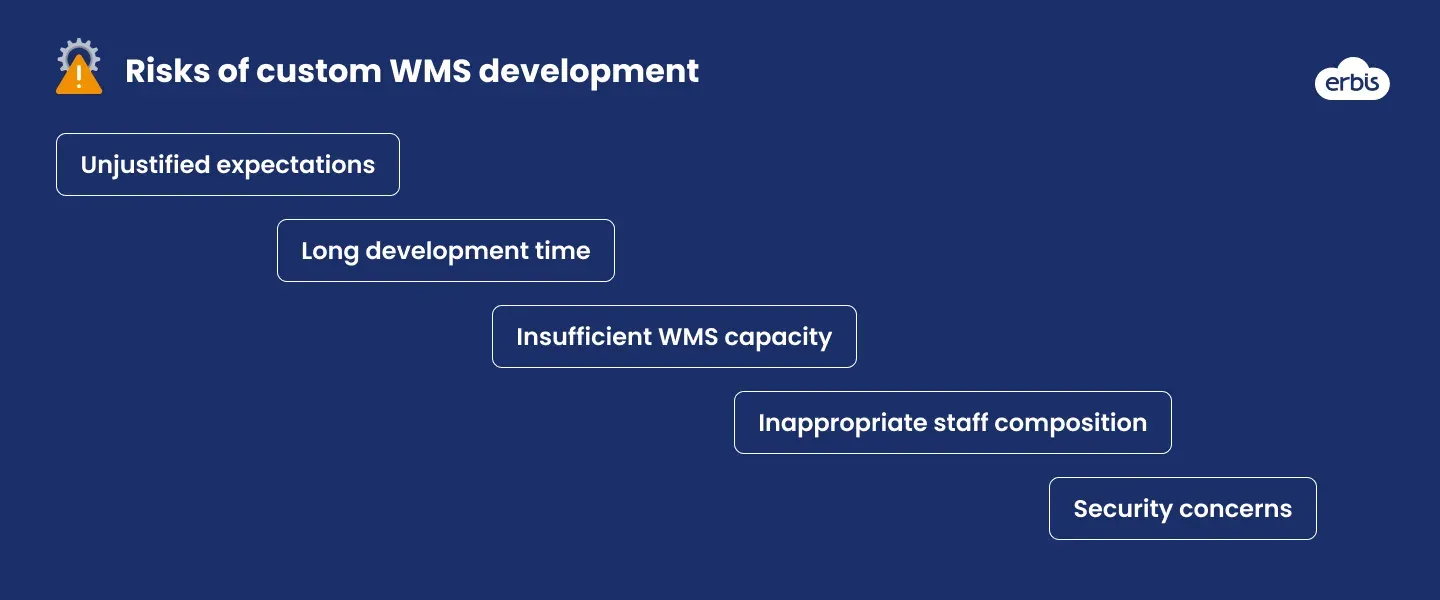
Unjustified expectations
The biggest risk is that the outcome is not what you expected: functionality, performance or integrations. Thorough business analysis and a scoped plan prevent most of it. With AI features, add a second safeguard: agree the metric each feature must move (pick path length, forecast error, overtime hours) before it is built, and measure it before and after.
Long development time
A WMS MVP takes several months. It should cover your basic operations and be built so features can be added or adjusted later. Keep expectations realistic: a fully functional custom system takes time. AI capabilities can be piloted in parallel on live data, which is why we run 4-week AI pilots alongside the core build.
Insufficient WMS capacity
If you expect rapid growth, the WMS must handle more operations, data and users. Building in the cloud is the practical answer. AWS and Microsoft Azure provide the tooling for fast implementation, testing and deployment, and you can keep the bill under control with known cost-saving practices.
Inappropriate staff composition
A WMS automates many tasks, so roles change. Define roles in advance and prepare training. With AI in the loop, add a review role: someone who checks the agent’s replenishment orders and the model’s slotting moves in the first weeks and feeds corrections back.
Security concerns
If you outsource development, sign a non-disclosure agreement, make the contract name you as the sole owner of the software and require source-code handover. Add data terms for AI: where training data is stored, whether any model is trained on your data, and who can access it. Erbis is ISO 27001 certified and builds inside the client’s own cloud account, which keeps data under your control from day one.
Custom WMS development and third-party integrations
A custom WMS is a set of tools built to automate and digitize your organization’s own processes. In most enterprises it lives inside the corporate software landscape, so design how it will communicate with the ERP, the TMS and finance from the start.
A custom WMS may also need to connect to external services: shipping platforms, payment gateways, IoT tools and route-planning systems. Give the API layer real attention. A well-designed API lets the WMS gain features from third-party services without rebuilding, and it is the same layer the AI capabilities above plug into.
Finding the right WMS development partner
If you are not sure where to find a reliable partner, follow this sequence:
- Ask colleagues. Recommendations still beat directories. Make a list.
- Check reputation. Read reviews on Clutch and GoodFirms and look for named clients.
- Filter the list. Evaluate technical expertise, related experience, the technologies in use and a portfolio of similar cases.
- Ask the AI questions. Which of their AI systems are in production, for how long, and what metric did each move? How do they evaluate a model before release? What do they log? Who owns the model and the code?
- Book a call. Discuss the project and ask for an estimate.
- Sign a contract that names you as owner of the code and the data.
How Erbis approaches warehouse AI
Erbis has built supply chain software since 2012 and run AI in production since 2017. Our 200 engineers work in San Francisco, Kraków and Dnipro, and 89% of our clients stay with us for more than 12 months.
We start with a 4-week pilot on one capability and one live data set, with a go or no-go decision at the end. Then we build the integration layer, the model and the agent, and hand over code and documentation. Examples of this in production include a supply chain management platform re-architected on AWS for a San Francisco logistics company, and an AI invoice-processing pipeline that digitizes about 95% of invoices without human intervention and saves $10M+ a year across the 10+ companies that use it.
If your warehouse costs are rising faster than your volume, contact us. We will tell you which lever to pull first. More on how we work in supply chain and logistics.
FAQ
What is the fastest way to reduce warehouse operating costs?
Fix slotting. Moving fast-moving SKUs closer to the packing station shortens pick paths immediately and needs no new equipment. AI slotting keeps that arrangement current as demand shifts.
Do I need a new WMS to use AI in the warehouse?
No. You need a WMS with reliable data and an integration layer that exposes orders, stock and locations. Slotting, forecasting and replenishment models run alongside the existing system.
How does agentic replenishment differ from automatic reorder points?
A reorder point is a fixed rule. A replenishment agent recalculates the reorder point from the forecast and supplier lead times, chooses among approved suppliers, and escalates anything outside its budget or rules to a planner. It reacts in hours instead of at the weekly review.
How accurate are computer-vision inventory counts?
Accuracy depends on label quality, lighting and camera placement, so a pilot on one zone is the right first step. In production the value comes less from the count itself than from the frequency: discrepancies are found daily instead of quarterly.