Generative AI in SaaS: Use Cases, Integration and Monetization
Five use cases, four integration patterns (managed API, RAG, fine-tuning, agents), how AI pricing works in 2026 without guesswork, and five monetization models.
Generative AI has moved from a feature SaaS companies announced to a feature customers assume. Enterprise spend on generative AI reached $37B in 2025, 3.2x the year before, according to Menlo Ventures, and a growing share of it flows through SaaS products rather than direct model subscriptions. The question for a SaaS team is no longer whether to add AI but which pattern to build, what it costs to run, and how to charge for it.
This is a 2026 update of an article first published in early 2024. The use cases and the monetization models held up. The models, the prices and the integration options did not. This version keeps the concrete tiers, updates the technology, describes pricing patterns instead of quoting numbers that would be wrong by next quarter, and adds the fourth pattern that did not exist at scale two years ago: agents that act inside your product.
What is generative AI in SaaS?
Generative AI in SaaS is any feature that produces new content (text, code, images, structured data, or actions) from a prompt and context, using a large language model or a related foundation model. It shows up in products whose purpose has nothing to do with content: a logistics platform that drafts a customer delay notice, a compliance tool that summarizes a regulation change, a BI tool that answers a question in plain language.
Three distinctions still matter when you scope a feature:
Generative versus predictive AI. Predictive models forecast from history: demand next month, the probability a shipment is late. Generative models produce content and, increasingly, actions. Most valuable SaaS features combine both: a forecast from a numeric model, explained and acted on by a generative one. See from predictive models to autonomous decisions.
Generative versus conversational AI. A chat interface is one way to expose a generative feature. It is not the only one, and often not the best. A button that drafts the report, a field that autocompletes the classification, a background job that enriches records: each is generative AI without a chat window.
Assistive versus agentic. An assistive feature proposes; the user accepts. An agentic feature acts, inside limits the user has set, and reports. The second requires tools, guardrails and escalation, covered in pattern 4 below and in from chatbots to AI agents.
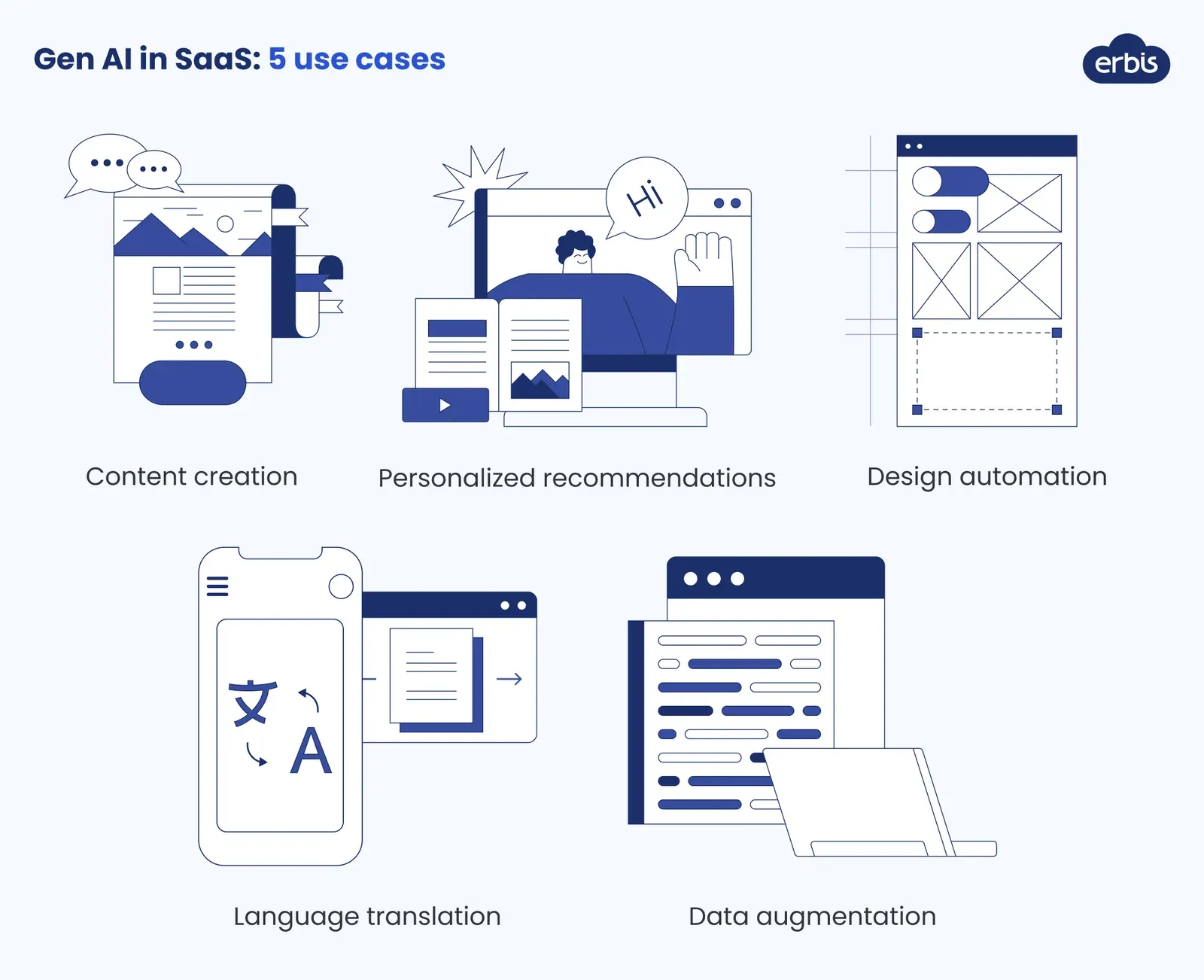
How to use generative AI in SaaS: 5 use cases
Content creation
Drafting inside the workflow: product descriptions in a commerce platform, customer notices in a support tool, first drafts of contracts in a legal platform. The 2026 standard is drafting from the customer’s own data and templates, with the source cited, not generic text. Example: CMS and marketing platforms such as HubSpot expose drafting and rewriting inside the editor.
Personalized recommendations
Recommendations were a predictive feature. Generative models add the explanation and the conversation. “Why this supplier” or “why this course next” is now answered in plain language from the same signals. Example: streaming and commerce platforms explain and adjust recommendations through natural-language interaction.
Design automation
Layouts, graphics and UI variants generated from a brief and a brand kit, then edited by the user. Example: Canva and Adobe Creative Cloud expose generation inside the design canvas.
Language translation
Real-time translation of chat, meetings, documents and product UI, with domain glossaries. Communication and collaboration SaaS benefits most. Example: Slack and Zoom translate messages and meetings in real time.
Data augmentation and analysis
Synthetic records for testing and model training, plus the larger 2026 use case: natural-language analysis of governed data. A user asks a question; the system writes the query, runs it against the warehouse under the user’s permissions, and returns a chart with an explanation. We built this for a multi-tenant SaaS on Amazon Redshift and QuickSight Q: 60% faster insights and 80% less manual reporting, with row-level security isolating each tenant’s data.
How to incorporate generative AI into SaaS: four patterns
There were three patterns in 2024. There are four now. They are cumulative: most mature products use two or three at once, behind one model abstraction layer, because model choice is no longer stable. Menlo Ventures found 37% of enterprises run five or more models in production and put enterprise LLM API share at Anthropic 40%, OpenAI 27% and Google 21%, a ranking that changed within a year. Build so you can switch.
Pattern 1: Call a managed model with no access to your data
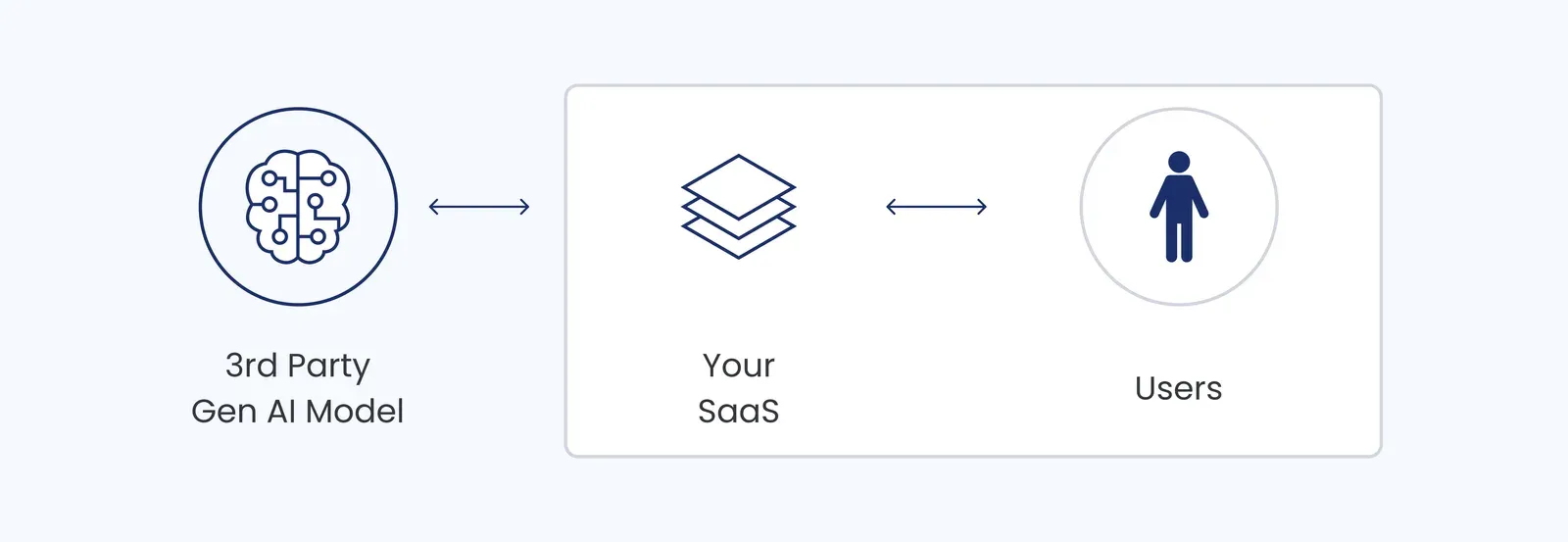
You call a hosted model through an API with the user’s input and a prompt. The model sees no proprietary data beyond what is in the request.
Advantage: Days to a working feature. No data pipeline.
Limitation: Generic output. The model knows the world, not your customer.
Use cases: Rewriting and summarizing user-provided text, sentiment and intent classification, translation, generic Q&A on public topics such as regulations.
AI technologies (2026): Claude via the Anthropic API or Amazon Bedrock; OpenAI models via the OpenAI API or Azure OpenAI; Gemini via Vertex AI; open-weight models such as Llama and Mistral hosted on Bedrock, Databricks or your own infrastructure.
Cost pattern: Per token, priced separately for input and output, with output typically several times the input rate. Most providers discount cached input (repeated prompt prefixes) and batch jobs that can wait hours. Cost scales linearly with usage, so metering per tenant from day one is what makes usage-based pricing possible later.
Pattern 2: Retrieval-augmented generation (RAG) over your data
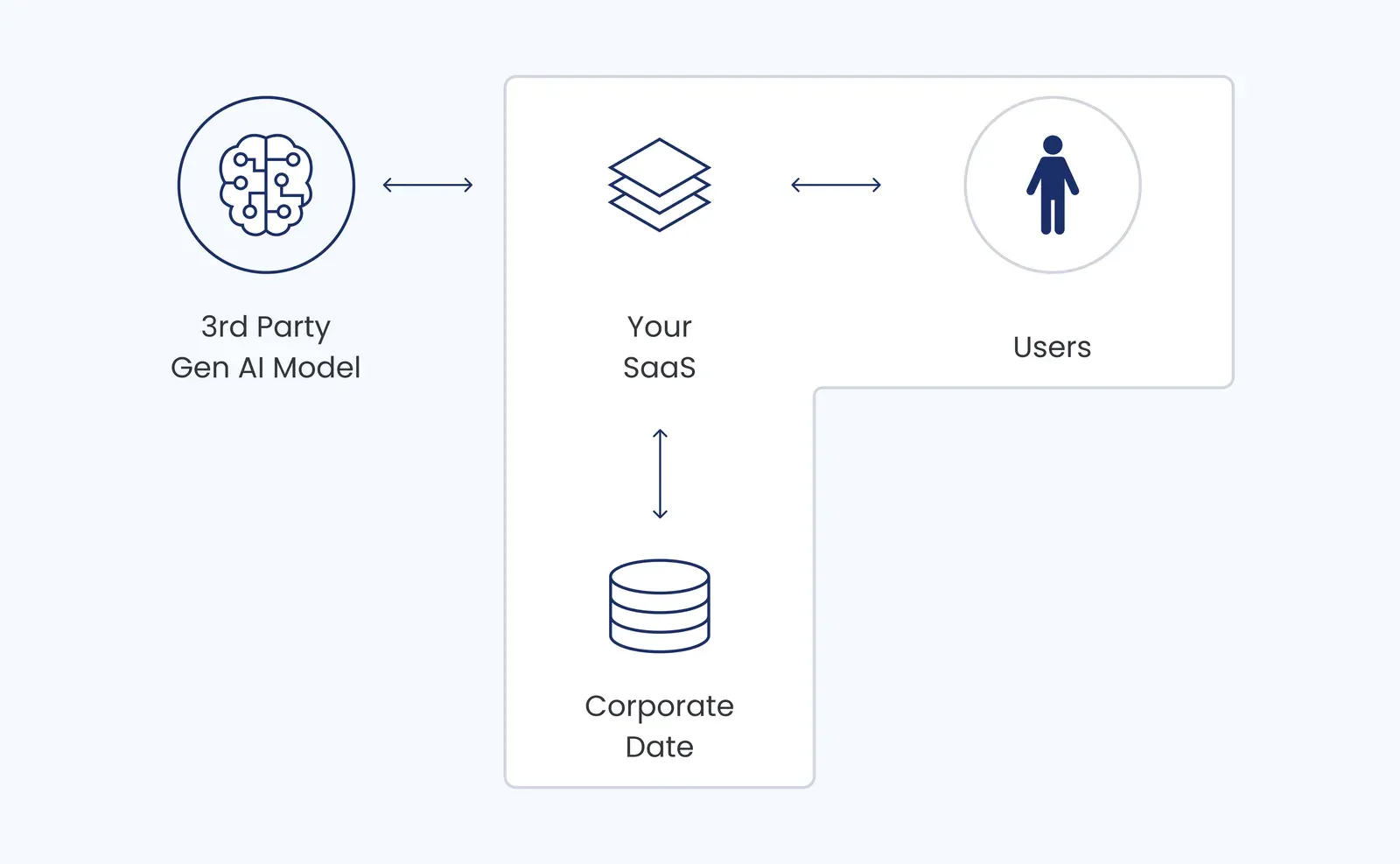
The pattern the 2024 article called “embeddings”. Your documents and records are indexed. At request time the relevant passages are retrieved and given to the model with the question. The model does not train on your data; it reads it.
Advantage: Answers grounded in the customer’s own content, with citations. Updates as the data updates, with no retraining.
Limitation: Retrieval quality decides answer quality. Chunking, indexing, permissions and freshness are engineering work, and evaluation is mandatory.
Use cases: Support and knowledge assistants, contract and policy Q&A, reporting from operational records, onboarding assistants, anything where “according to your documents” is the point.
AI technologies: The same model providers, plus an embedding model, a vector index (managed services on AWS, Azure and Google, or pgvector and OpenSearch), and increasingly hybrid search combining keyword and semantic retrieval. Databricks and Amazon Bedrock Knowledge Bases package the pipeline.
Cost pattern: Model tokens as above, plus a one-off indexing cost per document (embedding tokens), plus storage and query cost for the index. Retrieved context inflates input tokens, which is why prompt caching and retrieval limits matter. Cost is dominated by query volume, not corpus size.
Pattern 3: Fine-tune or train a model on your data
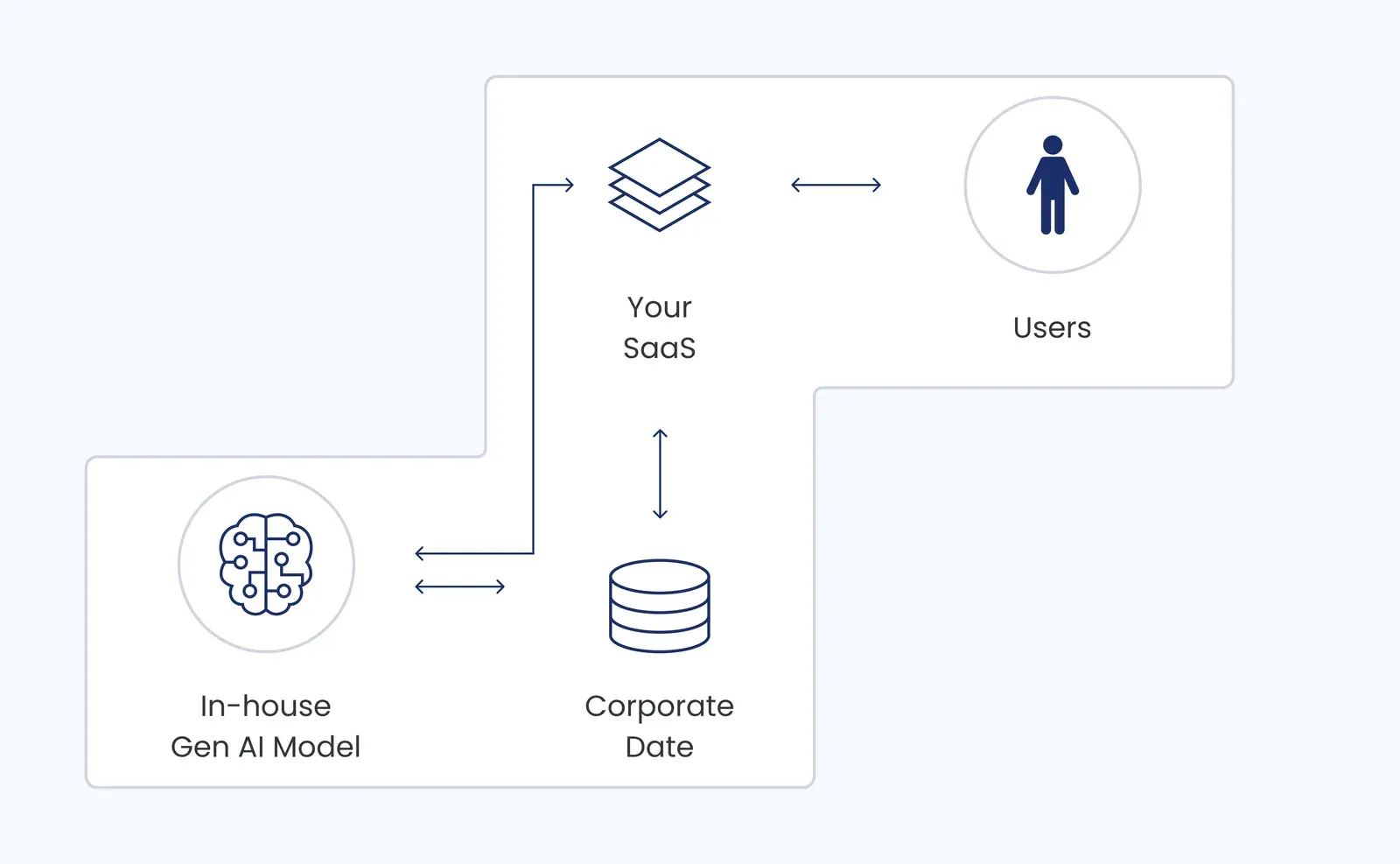
You adapt a foundation model to your domain, formats and tone by training on your examples, or, rarely, train a specialized model from scratch.
Advantage: Highest consistency for a narrow task, and lower per-request cost at very high volume, because a small tuned model can replace a large general one.
Limitation: Slowest and most expensive to build. Needs thousands of labeled examples. Must be re-evaluated on every base-model change. Fine-tuning does not add knowledge reliably; RAG does that.
Use cases: Regulated domains where output format and wording are fixed: legal drafting, clinical coding, financial document generation. For a law firm we built a custom-trained LLM with a verification controller that generates contracts 10x faster from 10,000+ precedents, saving 28,800 hours and €3.5M a year.
AI technologies: Amazon SageMaker, Azure Machine Learning, Google Vertex AI, Databricks Mosaic AI, Hugging Face, and managed fine-tuning endpoints from the model providers for their own models.
Cost pattern: Training is priced per GPU-hour or per training token. Hosting a tuned model is priced per hour of endpoint time or per token, depending on the platform. The hidden costs are data labeling and evaluation. Budgets run from tens of thousands to millions of dollars depending on model size and whether you fine-tune or pre-train. Anyone quoting a precise figure without seeing your data is guessing.
Pattern 4: Agents that act inside your product
The new pattern. The model gets tools: functions that read and write your product’s data and connected systems. It plans a multi-step task, executes it, and stops for approval where the user’s policy requires. An agent in a logistics SaaS re-books a delayed shipment. An agent in a finance SaaS prepares the month-end close. An agent in an IT SaaS provisions a user.
Advantage: The feature completes work rather than proposing it. This is what customers will pay for as a separate line item.
Limitation: The highest engineering bar. Guardrails, least-privilege tools, evaluation sets, tracing, budgets and a human escalation path are mandatory, and the security review is longer.
Use cases: Any repeatable workflow with a system of record and a clear owner. For an enterprise client we built two identity management agents that cut account setup from 15 minutes to under 1 minute and, by caching generated scripts, cut LLM API spend by 90%, at tens of thousands of transactions a month.
AI technologies: Claude, OpenAI and Gemini models with native tool use; LangGraph or LangChain for stateful orchestration; Bedrock Agents or Semantic Kernel where the stack is AWS- or Microsoft-native; Model Context Protocol (MCP) for standardized tool integration.
Cost pattern: Tokens multiply with steps. A ten-step agent run costs many times a single call. Costs are controlled with step and spend budgets per run, routing easy steps to small models, and caching. Meter per run and per tenant, because this is the pattern where usage-based pricing is both necessary and easiest to justify.
For what it takes to run pattern 4 safely, see agentic AI engineering.
What changes for a multi-tenant SaaS
Whichever pattern you pick, five requirements arrive with it:
- Tenant isolation. Retrieval and tools respect the tenant boundary and the user’s role. Row-level security in the warehouse, per-tenant indexes or metadata filters, and tests that prove a tenant cannot retrieve another’s data.
- Data handling terms. Whether prompts and outputs are retained, whether they train models, where they are processed. Buyers rank privacy and governance (61.3%) above accuracy (54.9%) as their top AI concern, per MarketScale, and procurement asks for it in writing.
- Evaluation. An evaluation set per feature, run on every model or prompt change. See evaluating AI systems in a pilot.
- Metering. Tokens, runs and cost per tenant, per feature, from the first release. It is the basis for pricing, for margin control and for the abuse limits you will need.
- Model abstraction. One internal interface over Claude, OpenAI, Gemini and open-weight models, so a provider change is a configuration change. Enterprise buyers now expect model-agnostic architecture.
How to monetize generative AI in your SaaS
The five models from 2024 still cover the market. What changed is that metering makes the usage-based ones practical, and agentic features make them necessary.
Subscription tiers. AI features included in higher plans. Simple to sell. Margin depends on capping heavy users. Example: HubSpot bundles AI features such as content drafting and predictive scoring into its paid tiers.
Usage-based pricing. Charged per unit consumed: messages processed, documents analyzed, minutes transcribed. Aligns cost with revenue when the underlying model cost is per token. Example: Twilio prices communication intelligence features per message or call processed.
Feature add-ons. AI capabilities sold as optional modules on top of a base plan. Lets you price the feature on its value rather than folding it into the tier. Example: Mailchimp has packaged predictive and generative features as premium capabilities on top of its base email plans.
Pay-per-use APIs. Developer-facing AI capabilities priced per call. Example: Google Cloud’s natural language and generative APIs are priced per request or per token.
Enterprise licensing. Custom agreements bundling AI capabilities, data handling terms, private deployment and support. The model for regulated customers who need pattern 3 or a VPC deployment. Example: Salesforce Einstein capabilities are packaged into enterprise agreements.
Two 2026 additions worth knowing:
- AI credits. A pooled allowance of AI usage across features, consumed at different rates per feature, sold with tiers and topped up. It hides token economics from the customer while preserving them for you.
- Outcome-based pricing. For agentic features that complete work, charging per completed task (per resolved ticket, per reconciled invoice) rather than per interaction. It only works with reliable metering and a measured success rate, which is why the evaluation set matters commercially as well as technically.
Getting started with generative AI in your SaaS
Start with one feature where the value is measurable in the customer’s own terms: hours saved, tickets deflected, reports produced. Pick the lowest pattern that delivers it. Do not fine-tune what RAG can answer. Build the evaluation set from real customer data in week 1. Meter from the first release. Ship behind a flag to a handful of design partners, measure, then price.
That is the shape of our AI Pilot in 4 Weeks: fixed fee, fixed timeline, a production-grade build on your data, and a go/no-go decision with a production plan at the end.
Erbis has built SaaS platforms since 2012 and production AI since 2017, with 200 engineers, $110M+ in documented client savings and ~95% AI accuracy in production. We are an AWS Partner (Select Tier) and a Databricks Consulting Partner, and we build on the model providers your customers already trust. For the SaaS fundamentals, see our guide to SaaS development from concept to launch.
FAQ
What is generative AI, and why is it in every SaaS product now?
Generative AI produces new text, code, images, structured data or actions from a prompt and context using large language models. It is in every SaaS product because the models are available through APIs at usage-based prices, customers expect drafting, summarizing and natural-language analysis inside the tools they already use, and enterprise spend on generative AI reached $37B in 2025, per Menlo Ventures.
What is the best use case of generative AI for a SaaS product?
The one where the output is measurable in the customer’s own metric and grounded in the customer’s own data: natural-language analysis of governed data, drafting from templates and records, and agents that complete a repeatable workflow. Generic content generation is easy to build and hard to charge for.
How much does it cost to integrate generative AI into SaaS?
It depends on the pattern. Calling a managed model is priced per token and can be live in days. RAG adds indexing, storage and retrieval costs and a few weeks of engineering. Fine-tuning or training runs from tens of thousands to millions of dollars, dominated by labeling and evaluation. Agents cost more per run and require guardrails and monitoring. In every pattern, run cost scales with usage, so meter per tenant from the first release and price accordingly.
Book a discovery call to talk through which pattern fits your product and what it would cost to run at your volume. We will tell you directly if a simpler pattern does the job.