Transportation Management Systems: Benefits and AI TMS in 2026
What a transportation management system does, the features and integrations to look for, five benefits with real company results, and how AI and agents are changing the TMS in 2026: route optimization, predictive ETA, freight audit and exception handling.

A transportation management system (TMS) is the software that plans, executes and settles the movement of goods: rate shopping, carrier selection, tendering, tracking, documentation, freight audit and analytics. It is now standard equipment. Inbound Logistics’ 2026 3PL Perspectives research found that 87% of third-party logistics providers run a TMS, with a visibility platform (83%) and ERP integration (73%) close behind.
The market has grown with that adoption. Grand View Research valued the TMS market at $10.45B in 2022 with a forecast growth rate of 14.8% a year to 2030. The next phase is already visible: Gartner forecasts that spending on supply chain management software with agentic AI will grow from under $2B in 2025 to $53B by 2030, and the TMS is where much of that capability lands, because it already holds the rates, the carriers and the shipment status.
This article explains what a TMS does, who needs one, the benefits with real company results, what AI and agents add in 2026, and how to choose between buying and building.
What features should you look for in a TMS?
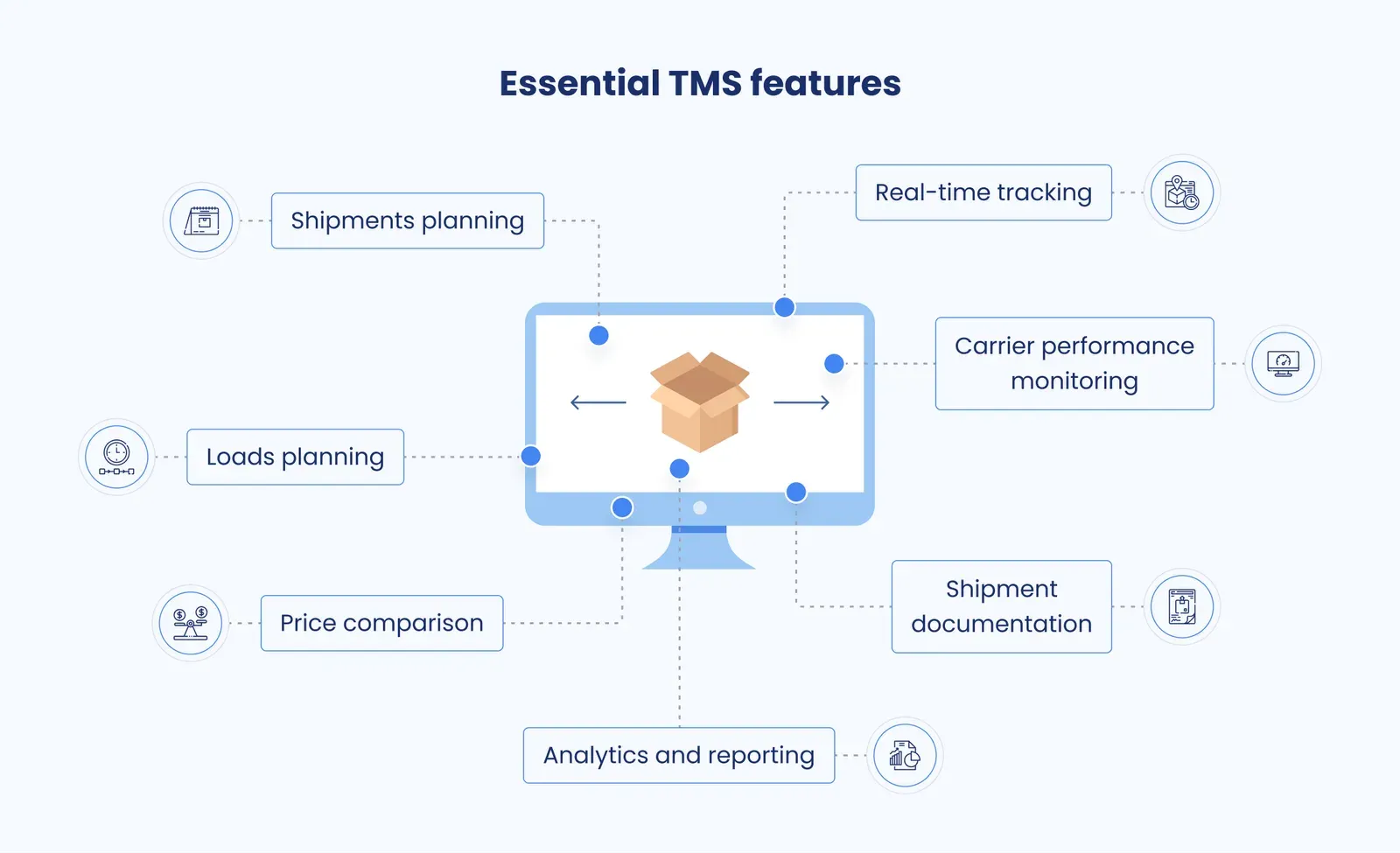
The primary job of a TMS is to make sending and receiving goods cheaper and more predictable. It does that through a core set of features:
Shipment planning. Create shipments electronically: weight, dimensions, pickup time, recipient. Track each one and receive notifications as it moves between checkpoints.
Load planning. Distribute loads across carriers and modes. Split a consignment between truck and air, order a dedicated vehicle, or spread a parcel shipment across several providers.
Rate comparison. Compare rates across carriers and service levels in one view and choose on price, transit time and reliability. For a carrier, compare the cost of different equipment and modes against the same goals.
Real-time tracking. Track multiple carriers on one map, receive alerts at waypoints and generate transit reports. Predictive ETA, covered below, is the 2026 extension of this feature.
Carrier performance monitoring. Score carriers over time on on-time delivery, transit time, claims and responsiveness, and use the scores in routing guides and contract negotiations.
Shipment documentation. Store and edit bills of lading, commercial invoices, packing lists and labels in one place.
Analytics and reporting. Track the indicators that matter to your operation and produce the mandatory industry reports, from shipment records to driver logs.
For a longer checklist, see our guide to must-have TMS features.
TMS is an integral part of corporate software
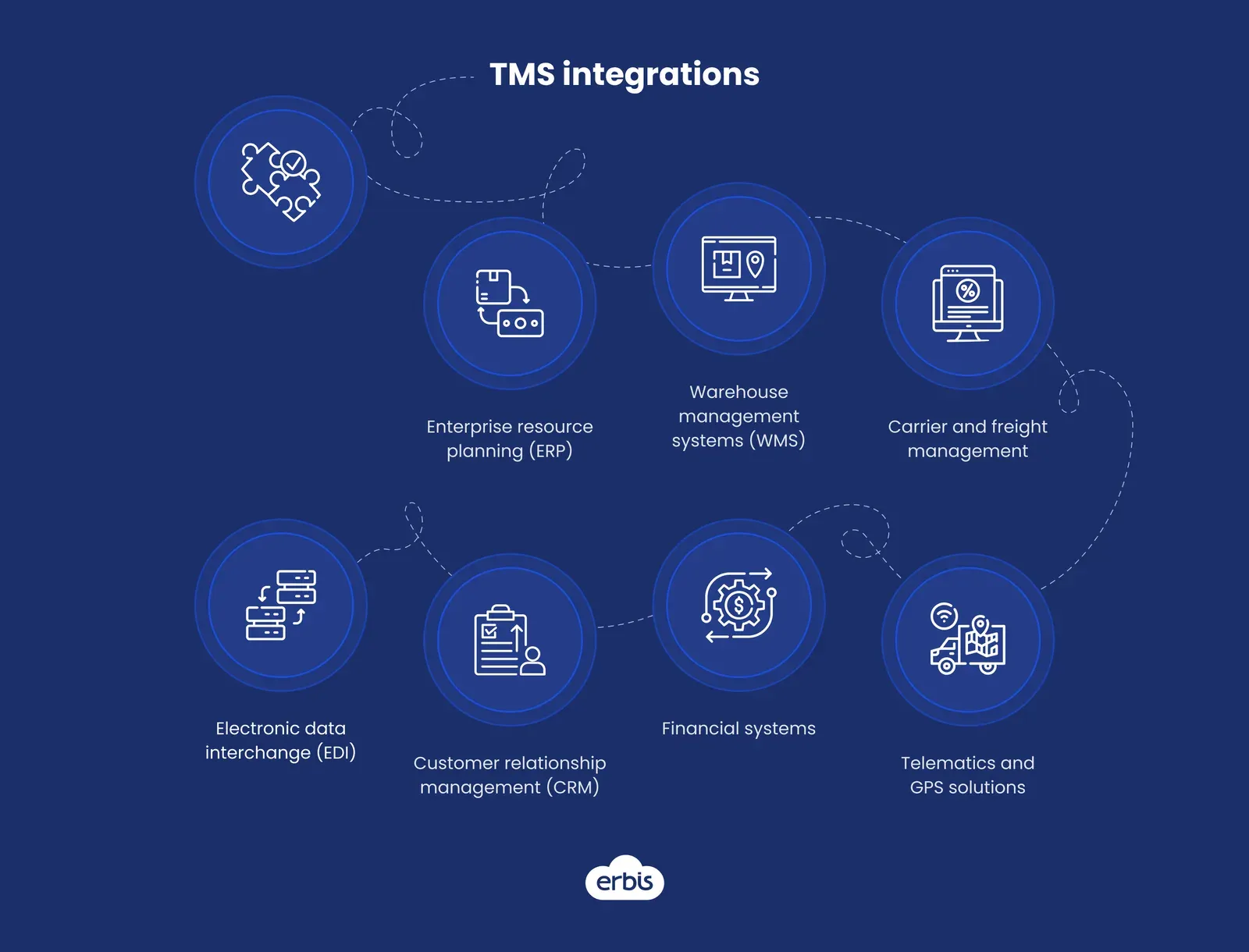
A TMS does not operate alone. Transportation is one step in a business process that starts with an order and ends with a paid invoice, so the TMS is integrated with the systems on either side of it. The most common integrations:
- Enterprise resource planning (ERP). Exchange orders, inventory and financial data.
- Warehouse management systems (WMS). Coordinate order fulfilment, dock scheduling and inventory movements.
- Carrier and freight management. Rate quotation, carrier selection, tendering and tracking through carrier APIs.
- Electronic data interchange (EDI). Document exchange with trading partners and carriers that do not offer web APIs. Our EDI integration guide for TMS covers the standards and the pitfalls.
- Customer relationship management (CRM). Customer-specific transportation requirements and service history.
- Financial systems. Automated billing, payment processing and cost allocation.
- Telematics and GPS. Live vehicle position and fleet performance.
Integration is also the hard part. Carriers alone use EDI, SOAP, REST and flat files, with different data models, shipment lifecycles and documentation quality. Erbis integrated 60+ carrier APIs across 30+ countries for a global TMS; the approach that scaled was a canonical shipment model with a per-carrier adapter, asynchronous processing and a sandbox built for every carrier that did not provide one.
Who needs a transportation management system, and why
A TMS is for any organization that moves goods regularly and wants transparency and control over how. Typical users:
- Freight forwarders and carriers
- Manufacturers and distributors
- Retailers and e-commerce companies
- Wholesalers and suppliers
- Healthcare and pharmaceutical companies
- Food and beverage producers
- Government agencies
These are the problems a TMS solves:
- Limited visibility. No single view of shipments across carriers and lanes.
- Manual processes. Data entry that consumes time and introduces errors.
- Inefficient routing. Routes and carriers chosen by habit rather than by cost and service.
- Weak rate negotiations. No lane-level performance and cost data to negotiate with.
- Inaccurate billing and payments. Discrepancies, invoicing errors and late payments.
- Uninformed decisions. No analytics to guide the transportation strategy.
- Poor customer service. Late deliveries and no proactive communication.
- Compliance risk. Missing records for standards such as Hours of Service and electronic logging devices.
- Difficulty handling exceptions. Disruptions and demand changes managed by phone and spreadsheet.
Need a TMS built around your operation? Talk to Erbis about the scope.
Benefits of transportation management systems
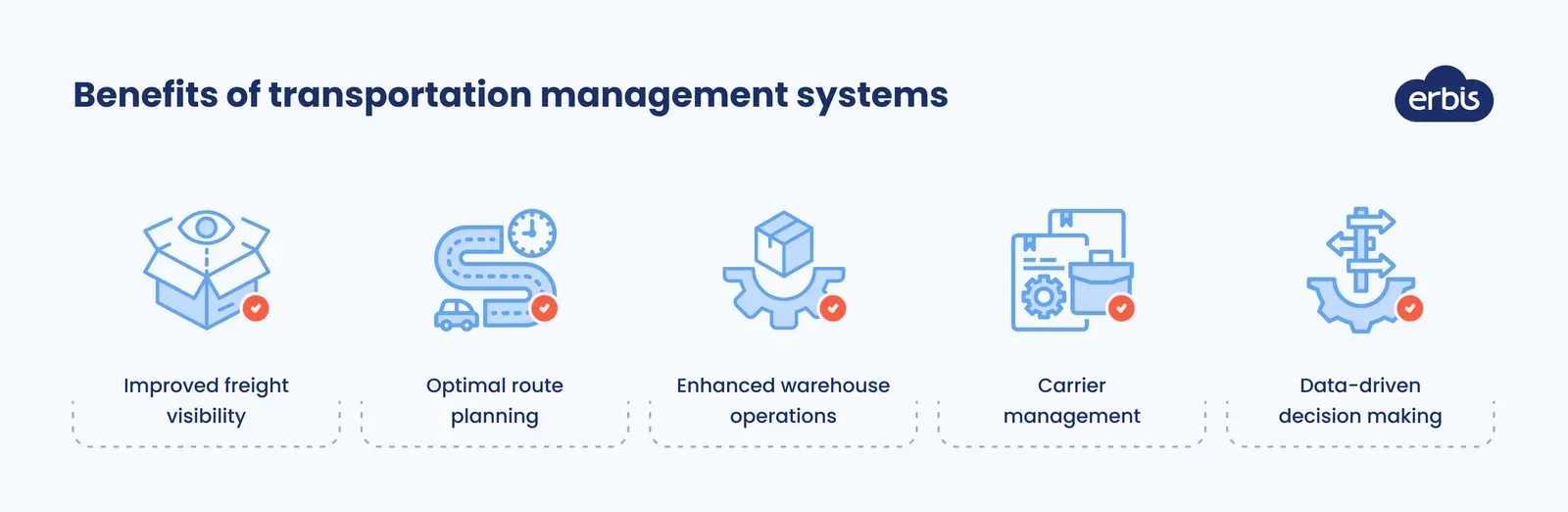
Five benefits follow from implementing a TMS. Each has a mechanism behind it.
Improved freight visibility
A TMS tracks vehicles and freight in real time:
- Each tracked vehicle carries a GPS-enabled telematics device
- The device transmits position data over cellular networks to the TMS
- The TMS stores position data for the whole fleet
- Dispatchers monitor progress on a dashboard or mobile app and respond to issues in transit
- Historical position data supports route analysis and carrier performance reports
Optimal route planning
A TMS plans delivery routes with optimization algorithms:
- It weighs distance, traffic, vehicle capacity, delivery schedules and customer preferences
- It consolidates shipments and finds backhaul opportunities to reduce empty miles
- It selects routes that minimize fuel use given speed limits, fuel prices and consumption rates
Enhanced warehouse operations
Integrated with the WMS, a TMS improves the flow of goods through the warehouse:
- Order confirmation triggers inventory allocation and dock scheduling
- Inbound and outbound transport are matched, enabling cross-docking without storage
- Repetitive tasks such as label printing and barcode scanning are automated
- Loading sequences match delivery routes, so the last stop is loaded first
Carrier management
A TMS digitizes collaboration with carriers:
- Carriers see shipment status and location through shared tracking
- Notifications fire on order confirmation, status changes and delivery
- Shipping documents are exchanged and stored electronically
- Carrier performance data supports selection and contract negotiation
- Shippers and carriers plan capacity in a shared workspace
Data-driven decision making
A TMS generates the data that logistics decisions depend on:
- Real-time tracking data on shipments, vehicles and delivery performance
- Built-in analytics that surface patterns and recurring issues
- Reports with lane-level cost and service metrics for planning and negotiation
AI and agentic TMS: what changes in 2026
The benefits above come from a conventional TMS. AI and agents extend each of them, and in 2026 they are the reason many companies are replacing or re-platforming their TMS. Gartner warns that supply chain software without agentic features will increasingly fail to meet customer requirements, and BCG’s 2026 logistics survey found that 64% of logistics service providers prioritize AI for transport planning and execution, the highest of any use case.
Five capabilities matter most.
Route optimization that learns
Classic route optimization solves a fixed problem with known inputs. AI-enhanced routing predicts the inputs: expected traffic by time of day, dwell time by customer, probability of tender rejection by carrier and lane. It re-optimizes continuously as events arrive, rather than once at planning time. The result is fewer miles, fuller trucks and fewer rejected tenders.
Predictive ETA
A predictive ETA replaces the carrier’s stated transit time with a model trained on your own shipment history: lane, carrier service, pickup time, distance, day of week and the latest transit status. Erbis built one for a transportation management SaaS on Amazon SageMaker: trained on 304,441 shipments across 60+ international lanes, the production model predicts delivery time with an RMSE of 21.4 hours and serves predictions through a REST API to the shipment management system. The promise date becomes a forecast with a confidence interval, and customer service can act before the customer calls.
Freight audit and invoice automation
Carrier invoices rarely match the quote exactly: accessorials, fuel surcharges, re-weighs and duplicates creep in. AI document extraction reads the invoice, matches it against the contracted rate, the tendered shipment and proof of delivery, and routes only the discrepancies to a person. Erbis’s AI invoice automation digitizes ~95% of invoices unattended, cut manual labour 15x and saves the 10+ companies using it more than $10M a year. Applied to freight bills, the same pipeline turns audit from a sampling exercise into a 100% check.
Exception-handling agents
Most TMS alerts are routine: a late pickup, a missed scan, a short shipment. An exception agent reads the alert, pulls context from the TMS and WMS, applies the playbook (re-promise the customer, chase the carrier, re-tender the load) and closes the case. It escalates when the playbook does not cover the situation or the financial impact exceeds a threshold. Gartner predicts that 60% of supply chain disruptions will be resolved without human intervention by 2031.
Carrier-communication agents
Tendering, rate requests, status chasing and document collection still run on email with many carriers. A carrier-communication agent sends the tender, parses the reply, updates the TMS, requests proof of delivery when the delivery event fires and drafts the claim for a damaged shipment. It works across carriers with APIs and carriers without them. Negotiation stays with people; the agent prepares the lane-level cost and performance history that makes the negotiation informed.
What makes these capabilities production-grade is the engineering around the model: guardrails on what an agent may do and up to what value, graduated autonomy that starts in recommend mode, an evaluation suite of real cases, and logs of every decision. This is the approach Erbis takes in agentic AI engineering. The integration layer underneath, carriers, ERP, WMS and telematics connected through governed APIs, is the AI automation and integration work that has to come first.
Real-world examples of companies that have implemented a TMS
Companies with an extensive supply chain cannot run logistics on spreadsheets. According to Coyote Logistics research, 98% of large and 83% of small companies use a transportation management system. Five documented examples, followed by Erbis’s own work.
AGCO
AGCO Corporation is a global agricultural equipment manufacturer headquartered in Duluth, Georgia. Rapid growth expanded its partner network and created chaos in transport operations.
AGCO implemented a transportation management system and partnered with a third-party logistics provider. The result was a transport cost reduction of 18% in Europe and 28% in China and North America, with improved network performance and lower inventory levels.
Terex
Terex Corporation manufactures lifting and material-handling equipment for construction, mining and transportation. Its manual yard management made locating and preparing equipment for delivery slow.
Terex deployed RFID tags and scanners with a yard management system. The time to locate a unit fell from six minutes to 30 seconds, and manual inventory counts were eliminated.
Avaya
Avaya provides communication and collaboration software. A series of acquisitions left its supply chain fragmented, with long cash-to-cash cycles, excess inventory and manual processes.
Avaya implemented a TMS on a cloud platform that integrated sales analysis, procurement, supplier communication and logistics planning, and focused the organization on a small set of KPIs. Inventory turnover improved and supply chain costs fell by 50%.
Sunsweet Growers
Sunsweet Growers operates the largest dried-fruit plant in the world. Demand forecasting was done manually in spreadsheets, and inaccurate forecasts drove high production costs.
Sunsweet adopted a supply chain planning suite and a sales and operations planning process. Forecast accuracy improved, plant resource requirements became predictable, and the company reduced the number of warehouses it needed.
Land O’Lakes
Land O’Lakes, the American agricultural cooperative, had empty miles and underused truck capacity across its network.
It adopted a lane-matching application that uses machine learning to pair shippers on common routes and reduce empty hauls. Asset utilization improved and transportation costs fell.
Transportation management system development: Erbis expertise
Erbis partnered with a logistics software company in San Francisco whose transportation platform, built years earlier, no longer met customer needs or competed with newer products. Speed and reliability under heavy load were the main requirements.
Over two years, a six-person Erbis team:
- Re-architected the platform from a monolith to microservices on AWS
- Built REST APIs to migrate to a new Angular front end
- Designed web forms that integrate into customer portals, including delivery-cost calculation and carrier price comparison
- Kept the existing platform running and shipped new features to existing customers throughout
The platform aggregates data from more than 40 US carriers and gives companies the tools to manage shipping rates, negotiate contracts and detect fraudulent activity. Downtime was eliminated and Fortune 500 companies use the software. Read the case study.
For a second, larger TMS we built the carrier connectivity layer: 60+ carrier APIs integrated across 30+ countries, including DHL, FedEx, UPS, USPS and DPD, over EDI, SOAP and REST. Automatic bidding, plain-language carrier error translation and shipment status within one minute of the carrier are part of the platform, which delivers $10M+ a year in optimized shipping costs for the client and its customers.
Transportation management systems: off-the-shelf vs custom
You can subscribe to a ready-made TMS or build one tailored to your operation. Each has trade-offs.
Ready-made TMS
Commercial TMS products offer standardized features that suit a wide range of businesses. You buy a subscription and start using it. It is usually cheaper up front, but it may not fit specific processes or non-standard requirements.
Pros
- Fast access to core features
- Vendor support and updates
- Lower initial cost
Cons
- Limited customization
- Dependence on the vendor’s roadmap
- Standard workflows that may not match yours
Custom TMS
Large and mid-sized businesses often build when a ready-made TMS cannot cover their requirements or becomes disproportionately expensive at their scale. A custom TMS delivers business-specific automation and, increasingly, the AI and agent capabilities described above. The cost is development investment and time.
Pros
- Built to your processes
- Scales without per-seat or per-shipment licensing
- You own the software and the data
Cons
- Development time
- Development cost
- The need for an experienced engineering partner
A common middle path: keep a commercial TMS as the system of record and build the integration, optimization and agent layer around it. That is where most of Erbis’s TMS work sits.
Considering a custom TMS or an AI layer on your current one? Request a scoping call.
How to choose a transportation management system
What works for one company does not always work for another. Three factors decide the choice.
Company size
A small business or startup needs a system that is easy to use and not overloaded with features. Parcel tracking, order fulfilment and basic rate comparison may be enough at the start, with room to grow.
An enterprise needs advanced analytics, lane-level reporting and integration with its existing WMS and ERP. In 2026 it also needs an API surface that AI models and agents can work through.
Industry
Different industries have different transportation requirements. Perishable goods need real-time tracking and temperature monitoring. Online retail needs e-commerce integration and route optimization for timely delivery. Chemicals need emergency-response and incident-reporting features.
Budget
With a limited budget, a ready-made TMS or a custom TMS with three or four core features is a reasonable start; extend it as the business grows. With sufficient resources, custom development delivers a system fully tailored to the operation and the AI capabilities that a standard product may not offer.
Developing a transportation management system with Erbis
Erbis has built logistics software since 2012 and run AI in production since 2017. The team is 200 engineers across San Francisco, Kraków and Dnipro, with 4,000+ integrations completed and $110M+ in documented client savings. 89% of clients stay with us for more than 12 months, and a Fortune 500 supply chain platform we run holds 99.999% uptime.
The process for a TMS engagement:
1. Discovery. Half of a project’s success is set by its goals. We meet with your decision-makers and operations team to understand why you need the TMS, which processes it must cover and which metrics it must move.
2. Engagement model. For long-term projects we propose a dedicated team. For scoped work, time-and-materials or fixed price. For AI capabilities, a fixed-scope four-week pilot proves the value on your data before you commit.
3. Contract. A software development agreement sets out rights, obligations, IP ownership (yours) and exit terms at every phase.
4. Development. We report progress, technical decisions and risks throughout. You can run the project yourself or use our technical lead to manage delivery and technology strategy.
5. Launch and support. After production launch you can hand over to your own team with full documentation or continue with maintenance and support from the engineers who built the system.
Not sure whether a TMS, or an AI layer on your current one, is the right move? Contact us and we will advise on the options.
FAQ
How does a TMS differ from a warehouse management system?
A TMS optimizes transportation: route planning, carrier management, tendering, tracking and freight settlement. A WMS manages warehouse operations: receiving, inventory tracking, picking, packing and shipping. The two are integrated so that order fulfilment and outbound transport are coordinated.
Is a TMS suitable for businesses of all sizes?
Yes. Small companies benefit from rate comparison and tracking; enterprises benefit from lane-level analytics, carrier performance management and integration with ERP and WMS. Coyote Logistics research found that 98% of large and 83% of small companies use one.
What is an agentic TMS?
A TMS in which AI agents execute routine work within defined limits: tendering loads and parsing carrier replies, resolving standard exceptions, auditing freight invoices and re-optimizing routes as conditions change. Agents recommend first and act autonomously only once their track record justifies it, with every decision logged. Gartner expects 60% of enterprises using supply chain software to adopt agentic features by 2030.
What are the key factors to consider when choosing a TMS provider?
Scalability, integration capability with your existing ERP, WMS and carriers, customization options, the API surface available for AI and agents, and the provider’s track record in delivering reliable support and updates. Ask for production references with numbers.
Ready-made TMS vs custom TMS: which should I choose?
A ready-made TMS offers quick implementation and lower initial cost. A custom TMS fits specific requirements, scales without licensing constraints and gives you ownership. Many companies keep a commercial system of record and build a custom integration and AI layer around it.
How long does it take to develop a custom TMS?
Typically six months to more than a year, depending on scope, integrations and features. An AI capability on an existing TMS, such as predictive ETA or freight audit, can reach production faster: Erbis’s invoice automation went live in under six months, and a scoped pilot takes four weeks.