Digital Twins and AI Simulation in Manufacturing and Supply Chain
What a digital twin is, how AI surrogate models and agent-run scenario planning change simulation for manufacturing and supply chain, and how to decide between a platform and a custom build.
Simulation software lets you test a decision before you make it. Change the takt time, add a machine, move a distribution center, cut safety stock, and see the result on a model instead of on the plant floor. That was true in 2023 when we first published this guide. What changed since is the data behind the model and the software around it.
In 2026 the useful term is digital twin: a simulation model that is fed by live operational data, calibrated against history, and used to run scenarios continuously rather than once a year. AI changes the twin in two ways. Learned surrogate models make slow simulations fast enough to run thousands of times. And agents can set up, run and compare scenarios on request, so planners ask questions instead of building models.
This guide covers what a digital twin is and is not, the simulation methods that matter for manufacturing and supply chain, where AI fits, the use cases with the clearest returns, and how to decide between a commercial platform and a custom build.
What a digital twin is, and what it is not
A digital twin is a model of a physical asset, process or network that is kept in sync with the real thing through data, and that can be run forward to predict behavior under conditions you choose.
Three properties separate a twin from a diagram or a dashboard.
- It is connected. Sensor, MES, ERP, WMS or TMS data update its state. A model built once from a spreadsheet is a simulation, not a twin.
- It is calibrated. Its predictions are checked against what actually happened and its parameters are corrected. A twin that has never been validated against history is a guess with graphics.
- It is executable. You can change an input and get an output. A 3D visualization that only shows current state is a viewer.
Twins come at four scopes: an asset (one press, one truck), a process (a line, a cell, a dock), a system (a plant, a warehouse) and a network (plants, DCs, suppliers and lanes). Scope sets the modeling method and the data you need.
Why simulation matters more in 2026
The reasons to simulate have not changed. You reduce risk by seeing the effect of a decision before it hits operations. You cut cost by not building or buying what the model shows you do not need. You align teams because everyone argues with the same model instead of with each other. And you find the cause-and-effect relationships in the operation that intuition misses.
What changed is the economics of downtime and disruption, and the fact that the data now exists. Manufacturers using AI report 30 to 50% less unplanned downtime and 25 to 40% lower maintenance costs (Deloitte, cited by AI Magazine). 77% of manufacturers use AI in some form (Metrology News). The same sources give the warning: 77% of AI manufacturing pilots never pass the prototype stage (Xenonstack, BuildMVPFast). A twin is one of the tools that gets a pilot to production, because it lets you test a control policy or a schedule against the real operation before you trust it with the line.
Three simulation methods and when to use each
Most manufacturing and supply chain twins use one of three methods, sometimes combined.
Discrete-event simulation (DES). The system moves from event to event: a part arrives, a machine finishes, a truck departs. Queues, resources and routing are explicit. Use it for lines, cells, warehouses, docks and any process where waiting and capacity drive the result. Most commercial manufacturing simulators are DES tools.
Agent-based simulation (ABS). Each entity has its own rules and state: a vehicle choosing a route, a customer placing an order, a supplier missing a date. System behavior emerges from the interactions. Use it for networks, demand behavior and disruption studies.
System dynamics. Stocks and flows with feedback loops, at an aggregate level. Use it for capacity strategy, inventory policy and multi-year planning where you care about the shape of the curve, not individual items.
Two more sit beside them. Physics-based simulation (finite element analysis, computational fluid dynamics) models the product or the machine rather than the process; it matters for design and for machine-level twins. Monte Carlo methods add randomness to any of the above so the output is a distribution, not a single number. Planners should see the distribution.
How AI changes simulation
Four techniques move simulation from a project to a capability.
Surrogate models. A physics or DES model that takes minutes per run cannot be used for optimization over thousands of scenarios. Train a neural network or a gradient-boosted model on a few thousand simulator runs and it predicts the same outputs in milliseconds. The surrogate does the search; the full model verifies the winners.
Data-driven calibration. Machine learning estimates the parameters the model cannot observe directly, such as true cycle-time distributions, changeover times by product pair and supplier lead-time distributions, from MES and ERP history. This is what keeps a twin honest.
Learned policies. Reinforcement learning and optimization trained inside the twin produce dispatching, replenishment and routing policies that can be evaluated, and constrained, before they touch the real system. Erbis built a shipment ETA model on AWS SageMaker for a global equipment manufacturer across 304,441 shipments and 60+ lanes with an RMSE of 21.4 hours; see the predictive ETA case study. Models like that become inputs to a network twin.
Agent-run scenario planning. A language-model agent with tools to configure the twin, launch runs, read results and write a comparison lets a planner ask “what happens to OTIF if we lose the Rotterdam lane for two weeks and add one shift in plant B” and get an answer with the assumptions listed. The agent does not decide. It runs the model, shows the numbers and cites the parameters it used. Guardrails limit which parameters it can change and require review before any policy is exported. This is standard agentic engineering: tools, evaluation, observability and a human in the loop.
Manufacturing use cases
- Line balancing and throughput. Model the line, find the constraint, test buffer sizes and operator allocation. The classic DES use, now re-run automatically when the product mix changes.
- Scheduling and changeovers. Evaluate a proposed schedule against the twin before releasing it to the MES; compare sequencing rules on real orders.
- Predictive maintenance policy. Combine failure predictions from sensor data with a twin to answer the question the prediction alone cannot: when is the cheapest time to intervene, given the schedule?
- Quality and yield. Trace yield loss to process parameters; simulate the effect of tighter control limits on throughput and scrap. Pairs with computer vision inspection data.
- Virtual commissioning. Test PLC logic and material flow on the twin before the equipment arrives, so the ramp-up is shorter.
- Capacity planning. Answer the capital question, add a machine, a shift or a plant, with a distribution of outcomes rather than a point estimate.
For plant-floor AI beyond simulation, see our manufacturing practice and the companion guide to industrial IoT and edge AI.
Supply chain use cases
- Network design. Where to put DCs, which lanes to use, how much inventory to hold where, under demand and lead-time uncertainty.
- Inventory policy. Test reorder points and safety stock across thousands of SKUs against simulated demand and supplier performance; the twin shows the service-level cost curve.
- Warehouse layout and slotting. DES of receiving, put-away, picking and shipping; compare layouts, slotting rules and automation options before buying equipment.
- Transportation and ETA. Route and load plans evaluated against predicted transit times and dock capacity; exceptions detected before customers call.
- Disruption stress tests. Lose a supplier, a port or a plant in the model and measure time to recover and cost to mitigate, then keep the playbooks.
- S&OP scenarios. Give the monthly planning cycle a model rather than a spreadsheet, and let the agent run the variants.
Our supply chain work applies these with the client’s own TMS, WMS and ERP data as inputs.
Commercial platforms vs custom build
The commercial market is mature. General-purpose simulation platforms such as AnyLogic, FlexSim, Simul8 and Arena cover DES and, in some cases, agent-based modeling, with 3D visualization and experiment managers. Engineering simulation platforms such as SimScale and the Siemens and Dassault suites cover physics-based modeling. Cloud services such as AWS IoT TwinMaker and NVIDIA Omniverse provide the data and visualization plumbing for connected twins. We do not publish pricing here; it changes often and is negotiated per seat, per core or per deployment.
Buy a platform when the process fits standard building blocks, your team can own the modeling, and the value is in the model rather than in integration or AI.
Build custom when the twin has to run continuously on live data, when it must be embedded in your own product or planning tool, when you need surrogate models and learned policies, or when the licensing model does not fit a fleet of models across sites.
Most production twins are hybrid. A commercial or open-source engine runs the simulation; custom software handles data ingestion, calibration, the AI layer, the scenario manager, the agent interface and the integration with MES, ERP and WMS. Erbis typically builds that surrounding system and connects it to whichever engine the client already licenses.
What a custom digital twin needs
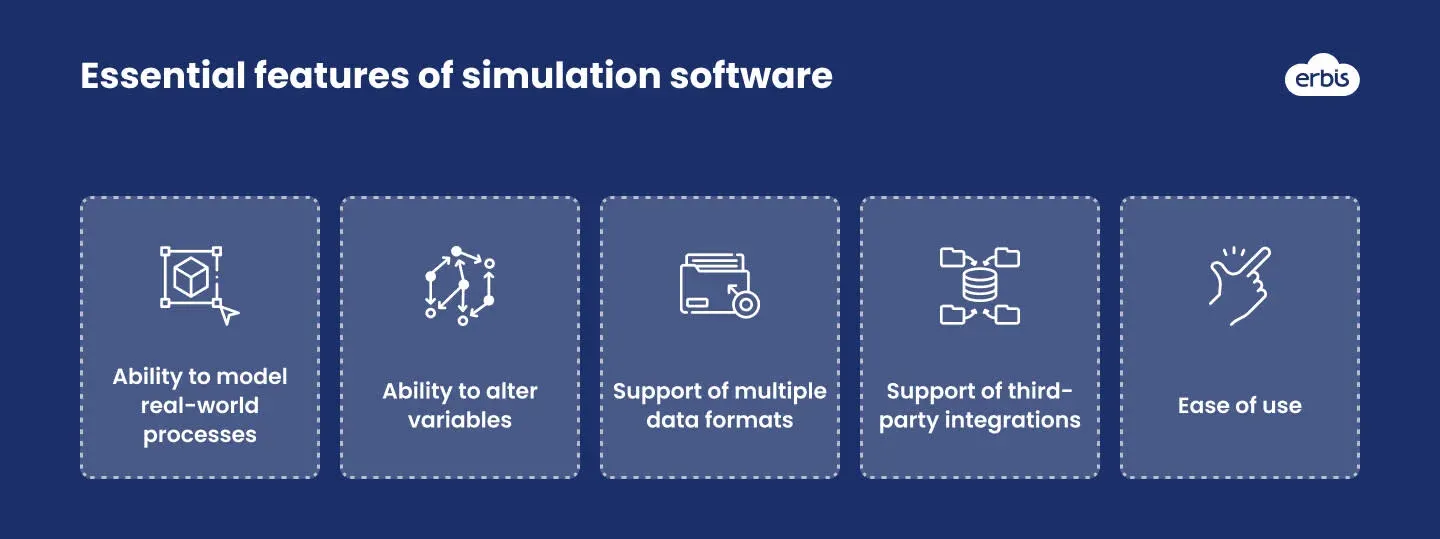
The five essentials from the original guide still hold: model real processes, change variables, read and write multiple data formats, integrate with third-party systems, and be usable by people who are not simulation engineers. A connected, AI-assisted twin adds the following layers.
- Data layer. Connectors for OPC UA and MQTT from machines, and APIs or change-data-capture feeds from ERP, MES, WMS and TMS. A time-series store for sensor data and a lakehouse for history.
- Model layer. The simulation engine, model versioning, and a calibration pipeline that re-fits parameters on a schedule and reports drift.
- AI layer. Surrogate training, optimization and policy learning, with an evaluation harness that compares every new model against the full simulator on a held-out scenario set.
- Scenario manager. Definitions, runs, results and comparisons stored as data, so any scenario can be re-run and audited.
- Agent interface. The tools the agent can call, the parameter ranges it may touch, and the approval step before anything is exported to a planning system.
- Integration and UI. Results pushed back to the systems planners use, and a UI that shows distributions, not only averages.
- Governance. Access control, model lineage and an audit trail of which model version supported which decision.
Building one: a step-by-step plan
- Pick the decision. One line, one warehouse, one network question, and the operating metric it should move: throughput, OTIF, inventory turns, downtime hours.
- Audit the data. What the model needs, where it lives, how clean it is. This step decides the timeline more than any other.
- Model the current state. Build the smallest model that reproduces last quarter’s results within an agreed tolerance. This is the calibration gate; do not skip it.
- Run the pilot scenarios. The three or four decisions the business actually faces. Compare on the distribution, not the mean.
- Add the AI layer where the runtime or the search space demands it: surrogate first, policies later.
- Integrate. Live data in, results out to the planning systems, scenario manager and agent interface for the planners.
- Operate. Recalibrate on a schedule, track prediction error against reality, retire scenarios that no longer matter.
Steps 1 to 4 fit inside a fixed-fee 4-week AI pilot for a well-scoped question. Steps 5 to 7 are the production phase.
Tech stack for a custom twin
The right stack depends on the method and the scale. A typical combination:
- Simulation engines: SimPy or Salabim (Python) for custom DES; AnyLogic (Java) where the client already licenses it; C++ solvers for physics models.
- AI: PyTorch or XGBoost for surrogates and calibration; optimization libraries such as OR-Tools; reinforcement learning frameworks where policies are learned; LLM agents built with tool calling, evaluation and observability.
- Data: MQTT and OPC UA collectors (AWS IoT Core, AWS IoT SiteWise or open-source brokers), a time-series database, and a Databricks lakehouse or an S3 and Redshift platform for history and features.
- Compute: Kubernetes or AWS Batch for parallel scenario runs; GPUs only where surrogates or physics need them.
- UI: React with Three.js or a commercial 3D layer where visualization matters; plain charts where it does not.
Erbis is an AWS Partner (Select Tier) and a Databricks Consulting Partner, and builds this data layer as part of its data and AI platforms practice.
Challenges and how to contain cost
- Data quality. The most common cause of a failed twin is a model fed by wrong master data. Fix the data before the model; the audit in step 2 is where most of the budget risk sits.
- Validation discipline. A twin that is never checked against reality loses trust the first time it is wrong. Publish its error rate.
- Model drift. Products, suppliers and machines change. Recalibration is an operating cost; plan for it.
- Adoption. Planners use tools that answer their questions in their language. The agent interface and the scenario manager are what make the twin used, not the 3D view.
- Scope. One decision first. The network twin can come after the warehouse twin proves the approach.
- Licensing. Check how a commercial engine is licensed for headless, parallel runs before you design an optimization loop around it.
Cost containment follows: set the goal, reuse an existing engine where one fits, model the smallest useful scope, and staff a small team with domain, simulation and data skills rather than a large generalist one.
What Erbis brings
Erbis has built software for manufacturers and supply chain operators since 2012 and production AI since 2017. For WH Bence we built an embeddable vehicle monitoring console that unified CAN-bus sensors and subsystems; for a German printing chain we modernized POS and ERP software running 25 shops; on AWS SageMaker we built shipment ETA prediction across 304,441 shipments. The same engineers build the data, AI and integration layers around a digital twin.
FAQ
What is the difference between simulation and a digital twin?
A simulation is a model you run. A digital twin is a simulation kept in sync with the real asset or process through live data and validated against history, so it can be run continuously for decisions rather than once for a study.
Do we need a 3D model for a digital twin?
No. Many high-value twins are discrete-event or network models with no 3D view. Visualization helps adoption for layout and commissioning work; it is not what produces the answers.
How much data do we need to start?
Enough to reproduce a recent period of operation: order history, cycle or process times, resource availability and, for network twins, lead times and demand. Sensor data improves calibration but is not a prerequisite for a first model.
Can an AI agent run simulations safely?
Yes, if the agent is limited to defined tools and parameter ranges, every run is logged with its assumptions, and a planner approves any policy before it reaches a production system. The agent proposes and explains; people decide.
If you have a decision you would rather test on a model than on the floor, talk to Erbis.