EHR Implementation Plan: 7-Step Checklist Updated for AI
A seven-step EHR implementation checklist for 2026: KPIs, current-state audit, Epic, Oracle Health, MEDITECH or custom, FHIR integration, AI documentation and prior-authorization automation.

An electronic health record (EHR) stores patient data in a structured, auditable form and makes it available to authorized users wherever care happens. Physicians get one view of the patient. Patients book, message and read results without visiting the clinic. Management and regulators get control over who saw what, and when.
The checklist below is the one Erbis has used since 2022, updated for what an EHR project involves in 2026: FHIR interoperability as a default requirement, AI documentation as a planned workstream rather than a bolt-on, and prior-authorization automation now that the CMS Interoperability and Prior Authorization Final Rule is in operational effect.
How long does EHR implementation take?
Two factors set the timeline: the size of the organization and the scope of the system.
A single-practitioner clinic that needs accounts, appointment booking and document upload can go live with a basic system in 3 to 4 months.
A multi-department clinic or hospital needs more: filters by department, doctor, hours and price; integrations with calendars, messaging and payments; notifications; analytics; internal communication; and, in 2026, an HL7 FHIR API surface, an ambient documentation workflow and a prior-authorization pipeline. That takes a year or more, and the integration and validation phases, not the build, usually set the pace.
Whatever the scope, write the plan down. Everyone involved should know what is happening and when. The seven steps below give you the frame.
EHR implementation steps
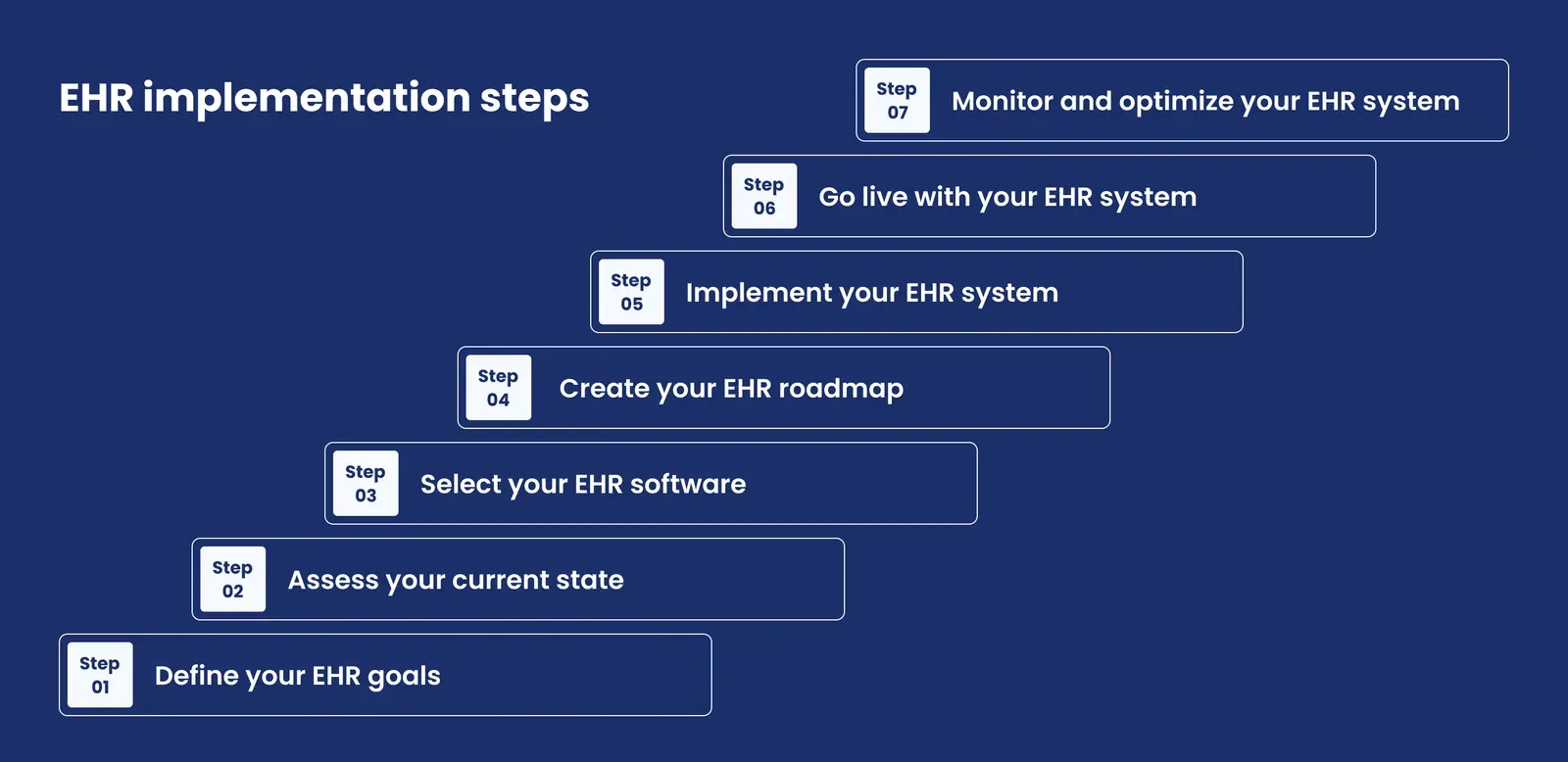
Step 1. Define your EHR goals and KPIs
Of the 96% of US hospitals that adopted an EHR, 60% could not say how to measure the benefit. Money spent, effect unknown. That is a planning failure, and it is avoidable.
Decide why you are doing this before choosing anything. Patient care, cost, throughput, revenue cycle, research? Then turn the goal into numbers you can read off the system every month. The indicators we still recommend:
- time to record information per encounter
- number of patients examined per clinician per day
- cost of patient care per episode
- speed of medical assistance (door-to-clinician, results-to-action)
- number of cases where medical information is lost or duplicated
Add the indicators that AI workstreams move:
- documentation minutes per encounter and after-hours documentation time
- prior-authorization turnaround in hours and first-pass approval rate
- claim denial rate attributable to documentation
- interface error rate and message backlog across HL7 and FHIR feeds
Providers’ number-one AI investment in 2025 was revenue cycle management, followed by clinical workflow (Bain and KLAS, October 2025). Your KPI list should cover both if you expect the EHR to carry AI.
Step 2. Assess your current state
Inventory what you have: systems, interfaces, data, people and process.
- Which systems hold patient data today (practice management, lab, imaging, pharmacy, billing), and how do they talk to each other: paper, HL7 v2 feeds, FHIR, CSV exports?
- What identity and access model do you run, and does it satisfy HIPAA’s unique-user, emergency-access and automatic-logoff requirements?
- How complete and consistent is the data you would migrate? KLAS reports data readiness as the number-one barrier to healthcare AI. It is also the number-one cause of painful migrations.
- Where does documentation time go now? Measure it; it is your baseline for Step 1.
You may be modernizing a legacy system or starting from scratch. Either way, decisions made without this inventory get revisited later at higher cost. If you are automating around an existing EHR rather than replacing it, our AI automation and integration work starts from the same audit.
Step 3. Select your EHR software
Decide between a commercial platform and a custom build, or a mix.
The large vendors are Epic, Oracle Health (formerly Cerner) and MEDITECH, with athenahealth, eClinicalWorks and NextGen strong in ambulatory settings. They cover a lot of ground, and that is also the complaint: broad feature sets, long implementation projects and pricing that scales with the licence. Many organizations with a specific workflow, a research use case or a product to sell choose custom development. It costs more up front and gives you a system shaped around your process.
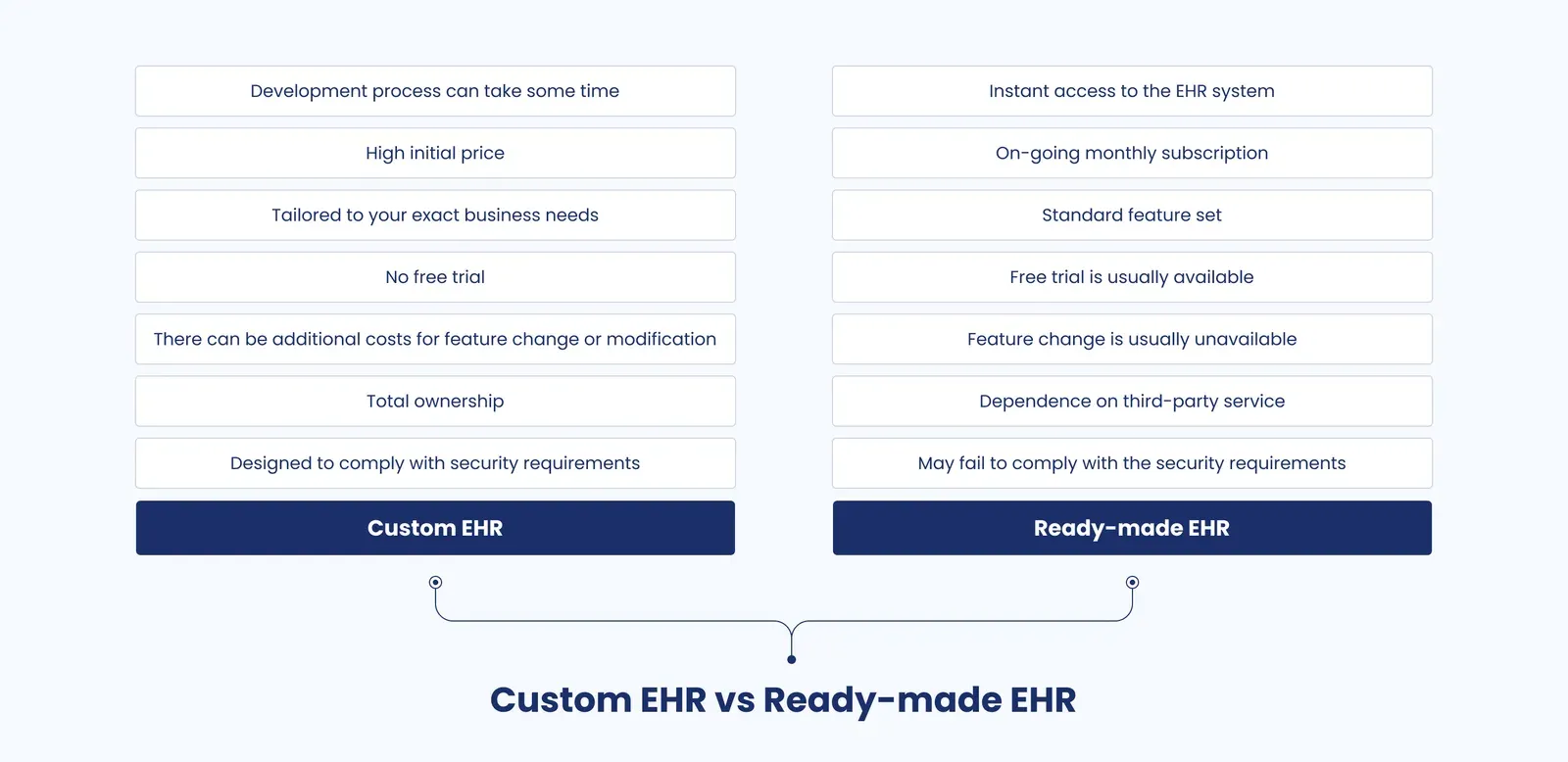
Whichever route you take, put these on the evaluation sheet in 2026:
- FHIR R4 API coverage for read and write, and SMART on FHIR app launch
- Support for HL7 v2 where legacy interfaces need it
- An app or partner program for ambient documentation, and whether the vendor offers a native scribe
- Prior-authorization capabilities aligned with the CMS rule (see below)
- Willingness to sign a business associate agreement covering all sub-processors, including AI services
- Audit logging you can export
- Data ownership and export terms at contract end
Step 4. Create your EHR roadmap
If you build, define the scope, sequence the features and set milestones. A product roadmap is the visual, high-level version; it changes as needs change, and the client should help write it. A release plan is the detailed, per-release document the development team owns.
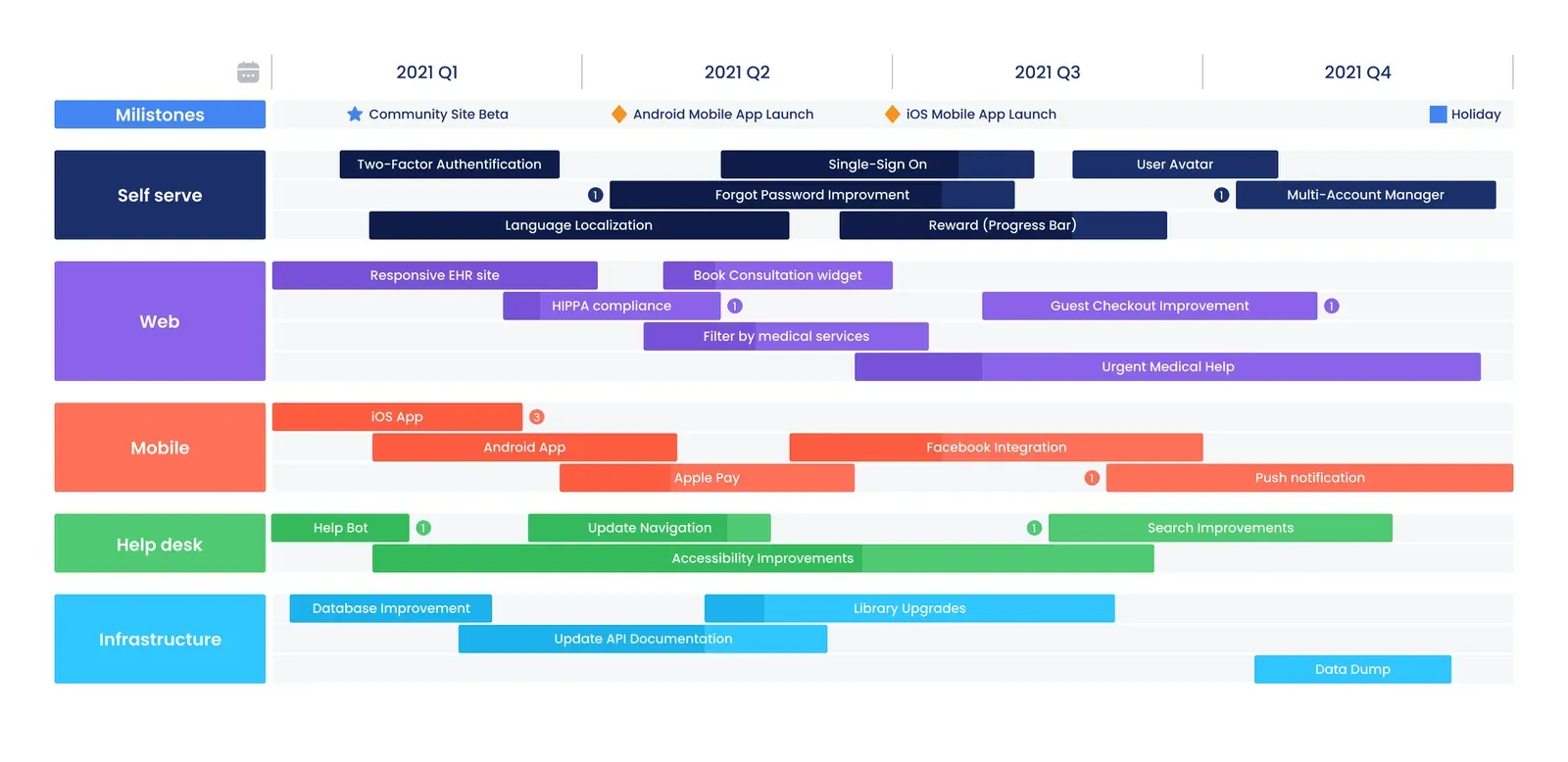
Two workstreams belong on every 2026 roadmap that did not exist on most 2022 ones:
- Interoperability. FHIR resources and HL7 feeds, the interface engine, and the vendor app-program review if you integrate with a commercial EHR.
- AI. Ambient documentation, coding support and prior-authorization automation, each with its own evaluation gate before rollout.
Sequence them after the core record and identity model are stable. AI on an unstable data model produces confident errors.
Step 5. Implement your EHR system
Build in-house or with a partner. A partner with healthcare experience starts faster and already knows the HIPAA safeguards, the EHR security risks and the integration patterns.
When choosing one, look at the specialization and at the portfolio. Erbis built a HIPAA-compliant clinical-research EHR for a French pharmaceutical company from the idea stage to production with a team of four, implementing unique user identification, emergency access, automatic logoff and encryption in the application layer. That is the level of detail to ask any vendor about.
Run the build in short iterations with clinicians reviewing working software every sprint. The people who will use the system are the only reliable test of whether the workflow fits.
Step 6. Go live with your EHR system
Before the switch:
- Train every user role on the new system with specialty-specific scenarios, and keep a floor-walker on each unit for the first weeks.
- Test end to end: registration to discharge, order to result, encounter to claim, including the HL7 and FHIR interfaces under production-like load.
- Migrate data in a rehearsal run, reconcile counts, and only then in production.
- Prepare a rollback plan and a downtime procedure.
- Tell patients what is changing and how to access their records and portal.
For AI features, go live in shadow mode first: the model produces output and clinicians see it, but the old process remains the system of record until the evaluation gate passes.
If you want help with any of this, Erbis supports healthcare organizations through every step, from planning to execution.
Step 7. Monitor and optimize your EHR system
The system is not finished at go-live.
- Review the KPIs from Step 1 every month and act on the gaps.
- Watch interface health: message backlog, rejected messages, mapping errors.
- Fix inefficiencies and defects as they surface, prioritized by clinical impact.
- Keep training new staff, and retrain existing staff when workflows change.
- Apply security patches and vendor updates on a schedule.
- Re-evaluate AI components after every model update; accuracy can move without any change on your side.
- Retire features nobody uses; they carry maintenance and security cost.
Adding AI documentation to your EHR plan
Ambient documentation is the most visible AI use case in healthcare, with 1 in 5 providers at full rollout (Bain and KLAS, October 2025). In an EHR plan it is a workstream with four parts.
- Capture and consent. A session start inside the EHR context, a recorded consent step and a non-ambient fallback.
- Generation. Speech recognition with speaker separation, then a language model that drafts the note, proposes codes and extracts orders, with every sentence linked to its evidence in the transcript.
- Review. A clinician signs every note. Medications, doses and orders are structured and validated against the chart, never free-generated.
- Write-back. The signed note enters the EHR as a
DocumentReferenceorCompositionover FHIR, or as an HL7 v2 MDM message.
Governance sits across all four: business associate agreements with every AI vendor, PHI-safe model deployment with no training on your data, retention limits on audio, and audit logs. We cover the pipeline and the safety design in detail in Ambient AI scribes and clinical speech recognition.
Pilot on one specialty with a fixed set of metrics before extending. The 4-week AI pilot format works well here because the go/no-go criteria are easy to state.
Prior-authorization automation and the CMS rule
The CMS Interoperability and Prior Authorization Final Rule took operational effect on 1 January 2026. Affected payers must now decide standard prior-authorization requests within 7 calendar days and expedited ones within 72 hours, give a specific reason for denials, and publish metrics. The rule also moves prior authorization onto FHIR-based APIs on a later deadline, so both payers and providers are re-platforming the workflow.
For a provider, the EHR plan should include a prior-authorization pipeline with five steps, each with a human checkpoint where the decision carries clinical or financial risk:
- Determine whether authorization is required for the order and the payer, from payer rules rather than memory.
- Assemble the documentation from the chart: the note, the relevant results and the payer’s criteria, using the same extraction components as the scribe.
- Submit through the payer’s API or portal and record the reference.
- Track status against the 7-day and 72-hour windows and escalate before a deadline passes.
- Handle denials: draft the appeal against the cited reason and route it to the clinician for review.
Demand is there: 80% of health systems were exploring or piloting generative AI for revenue cycle management, up from 58% in 2023 (HFMA and AKASA). Two cautions from the same research base. PHTI’s January 2026 review warns that AI layered on flawed administrative workflows “exacerbates the underlying issues”, so map and fix the workflow before automating it. And every automated decision needs an audit trail a payer or auditor can follow.
Custom EHR development: team and budget
Costs depend on scope. A qualified team will quote after reviewing requirements, current documentation and the target integrations. The cost lines to expect:
- infrastructure (cloud or on-premises servers)
- database design and setup
- patient data migration
- web and mobile applications
- interfaces for patients, clinicians and administrators
- UI/UX design
- FHIR and HL7 integration, and vendor app-program certification if applicable
- AI components: speech, language models, evaluation and monitoring
- testing, QA and security review
Cloud deployment usually costs less to start and scales with use; on-premises may be required by policy in some organizations. A non-complex EHR starts from roughly $30,000; integrations, AI workstreams and certification move the number up quickly, and a plan that covers them is more useful than a low estimate that does not.
A typical Erbis team for an EHR build is a business analyst who also manages the project, back-end and front-end developers, a QA engineer and a UI/UX designer, with data and AI engineers added for the AI workstreams. Erbis holds ISO 27001 certification and has built healthcare systems since 2012.
FAQ
Is Cerner still an EHR vendor?
Cerner was acquired by Oracle and now operates as Oracle Health. Existing Cerner Millennium installations continue under that name, with Oracle Health’s roadmap for cloud and AI features.
Does a custom EHR need to support FHIR?
Yes. FHIR R4 is the practical standard for exchanging data with other providers, payers and patient apps, and the CMS interoperability rules assume it. Plan the API surface from the start; retrofitting it is expensive.
Should AI documentation be in the first release?
Usually not. Stabilize the record, identity and interfaces first, then add ambient documentation as its own workstream with an evaluation gate. AI on an unstable data model produces errors that look correct.
How long does prior-authorization automation take to implement?
A pilot for one service line and one or two payers can run in about 4 weeks on top of an EHR with a FHIR API. Extending across payers depends on their API readiness.
For a detailed estimate based on your organization and system expectations, contact Erbis.